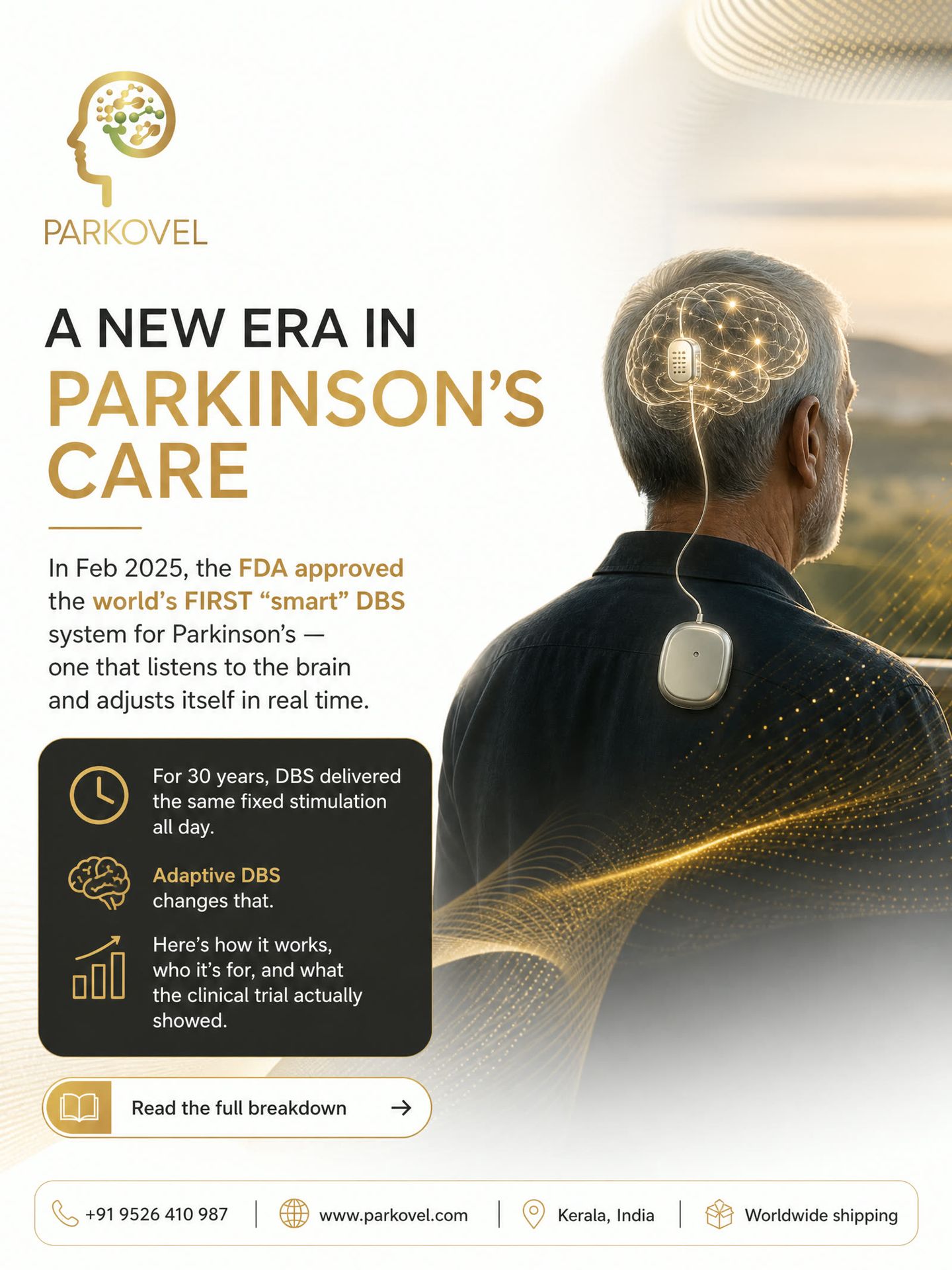
For thirty years, deep brain stimulation (DBS) has helped people with advanced Parkinson's disease regain motor control when medication alone stops working well. In February 2025, that technology took its biggest leap forward yet: the FDA approved the world's first adaptive DBS system, a device that listens to the brain and adjusts itself in real time.
From Constant Stimulation to a Responsive System
Traditional DBS works by implanting electrodes that deliver constant electrical stimulation to specific brain regions, at settings a doctor programs during periodic clinic visits. It works, but it's a blunt instrument — the same stimulation level whether a patient is walking briskly or sitting still, whether symptoms are flaring or quiet. Current open-loop continuous DBS has inherent limitations, including side effects, rapid battery drain, and the need for frequent manual reprogramming.
What Makes Adaptive DBS Different
In February 2025, Medtronic received FDA approval for BrainSense Adaptive DBS, representing a significant breakthrough for the roughly one million people diagnosed with Parkinson's in the United States. The closed-loop system dynamically self-adjusts DBS therapy to individual brain activity in real time, providing personalised neuromodulation that responds to a patient's changing needs from moment to moment — rather than delivering the same fixed signal all day.
The Evidence Behind the Approval
The approval rested on the ADAPT-PD clinical trial, which tested whether adaptive stimulation based on brain "beta oscillations" (electrical patterns linked to Parkinson's motor symptoms) could outperform standard continuous DBS. At the group level, overall patient well-being improved significantly with adaptive DBS, with a trend toward better general movement as well — a meaningful result for a therapy that had barely changed in three decades.
Who Is a Candidate for DBS?
DBS, adaptive or otherwise, isn't a first-line treatment. It's generally considered for people with Parkinson's who still respond well to levodopa but experience motor fluctuations, unpredictable "off" periods, or medication-related dyskinesia that significantly affects daily life. It is a surgical procedure and requires careful evaluation by a movement disorder specialist — it is not suitable for every stage or type of Parkinson's.
Why This Matters Beyond the Technology
Adaptive DBS represents a broader shift in Parkinson's care: toward therapies that respond to the individual, in real time, rather than applying one protocol to everyone. It sits alongside other personalised approaches — digital symptom tracking, tailored medication timing, and individualised rehabilitation — that are reshaping how neurologists manage a disease that looks different in every patient.
Frequently Asked Questions
Is adaptive DBS available in India?
Adaptive DBS technology is new and rolling out gradually; availability varies by hospital and region. Patients should ask their movement disorder specialist about current device options at major neurology centres.
Does DBS replace medication?
No. Most people continue some level of medication after DBS, though many can reduce their dosage and experience fewer fluctuations.
Is adaptive DBS reversible?
The stimulation itself can be turned off or adjusted, but the surgical implantation is a significant procedure. It's typically considered after other treatment options have been optimised.
How is adaptive DBS different from standard DBS in daily life?
Because it self-adjusts to brain activity, patients often need fewer in-clinic reprogramming visits, and some report smoother symptom control across changing daily activities.
If surgery isn't the right stage for you or your loved one, non-surgical and complementary approaches — from structured exercise to Ayurvedic formulations like Parkovel365 — remain valuable parts of a broader Parkinson's care plan. Always discuss any treatment decision, surgical or otherwise, with a qualified neurologist.
Sources
- Medtronic News, "Medtronic earns U.S. FDA approval for the world's first Adaptive deep brain stimulation system for people with Parkinson's" (Feb 24, 2025)
- Medscape, "FDA OKs First Adaptive DBS System for Parkinson's Disease" (2025)
- npj Parkinson's Disease, "Chronic adaptive deep brain stimulation for Parkinson's disease: clinical outcomes and programming strategies" (2025)