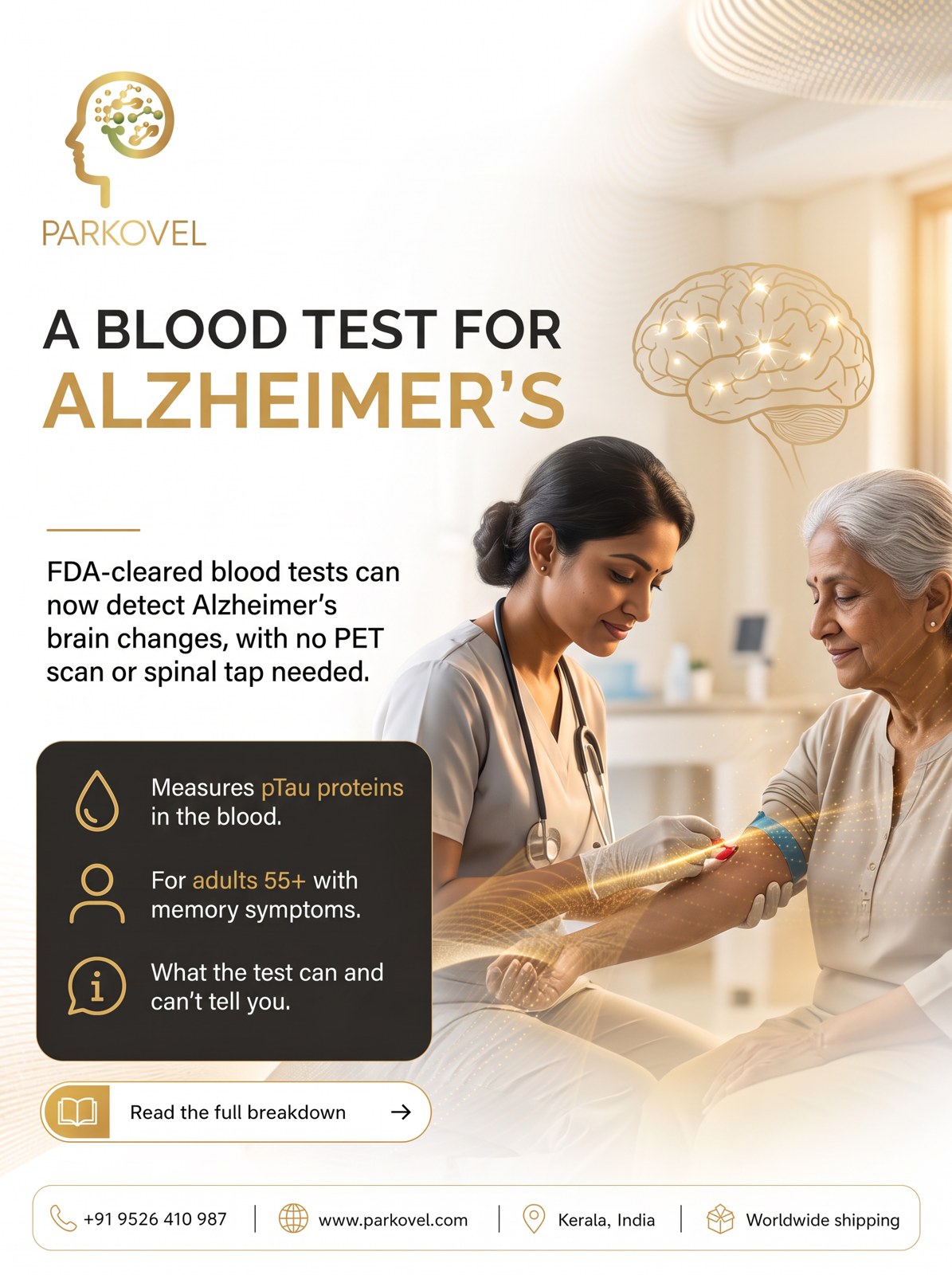
Until recently, confirming the brain changes of Alzheimer's disease meant an expensive PET scan or a lumbar puncture to sample spinal fluid. That has changed. Since 2025, the US FDA has cleared blood tests that can detect signs of Alzheimer's pathology from a simple blood draw — one of the most practical advances in dementia care in decades.
What the Tests Measure
Alzheimer's disease is defined by two abnormal proteins in the brain: amyloid plaques and tangles of tau. As these build up, tiny amounts of related proteins appear in the bloodstream. The newest tests measure forms of tau protein called phosphorylated tau (pTau217 and pTau181), sometimes combined with amyloid-beta levels, to estimate whether amyloid plaques are present in the brain.
The Cleared Tests
Three blood tests have now been cleared by the US FDA, all for adults aged 55 and older who already show signs or symptoms of cognitive decline:
- Lumipulse G pTau217/β-Amyloid 1-42 Plasma Ratio (Fujirebio), cleared on 16 May 2025: the first such test, used in specialist care to help identify amyloid pathology. Its results agreed closely with PET scans and spinal-fluid tests.
- Elecsys pTau181 (Roche), cleared in October 2025: the first cleared for primary care, designed mainly to help rule out amyloid pathology. In its key study it had a 97.9% negative predictive value, which helps doctors decide who does not need specialist referral.
- Elecsys pTau217 (Roche, developed with Eli Lilly), cleared in August 2026: a single-biomarker test that supports both ruling in and ruling out amyloid pathology in primary and specialist care, reporting positive, intermediate or negative results.
Why This Matters
Two approved antibody treatments for early Alzheimer's — lecanemab (Leqembi) and donanemab (Kisunla) — work only in people with confirmed amyloid pathology, and they work best early. Blood tests make confirmation faster, cheaper and far less invasive, which could help more people reach an accurate diagnosis in time. Lecanemab is now also available as a subcutaneous injection for maintenance (Leqembi Iqlik), which reduces hospital visits. Both drugs modestly slow decline rather than stopping it, and both carry a risk of brain swelling or small bleeds (ARIA) that needs MRI monitoring.
What the Tests Can't Do
- They are not screening tests for healthy people without symptoms.
- A positive result shows amyloid is likely present; it does not by itself diagnose dementia or predict exactly when symptoms will progress.
- Results must be interpreted by a clinician alongside memory testing and other assessments.
Relevance for Parkinson's Families
Cognitive changes are common in later Parkinson's, and some people have mixed pathology, with Alzheimer's-type changes alongside Parkinson's. As blood biomarkers spread, neurologists will be better able to tell which processes are driving a person's symptoms — and choose treatment accordingly.
Frequently Asked Questions
Can I get an Alzheimer's blood test in India?
Some specialised laboratories and hospitals offer blood biomarker tests for Alzheimer's. Ask a neurologist whether testing is appropriate and how to interpret it.
Should I get tested if I have no memory problems?
Current guidance does not recommend these tests for people without symptoms outside research studies.
Does a positive test mean I have Alzheimer's?
It indicates likely amyloid pathology. None of these tests is meant to be used alone; a diagnosis requires full clinical evaluation.
Are the new Alzheimer's drugs available in India?
Availability and approval status vary; discuss current options with a neurologist.
Sources
- US FDA announcement on the Lumipulse G pTau217/β-Amyloid 1-42 Plasma Ratio (May 2025)
- FDA 510(k) records and Roche announcements for Elecsys pTau181 (October 2025) and Elecsys pTau217 (August 2026)
- University of Washington Clinical Trials, "Year in Review: Alzheimer's Disease" (November 2025)