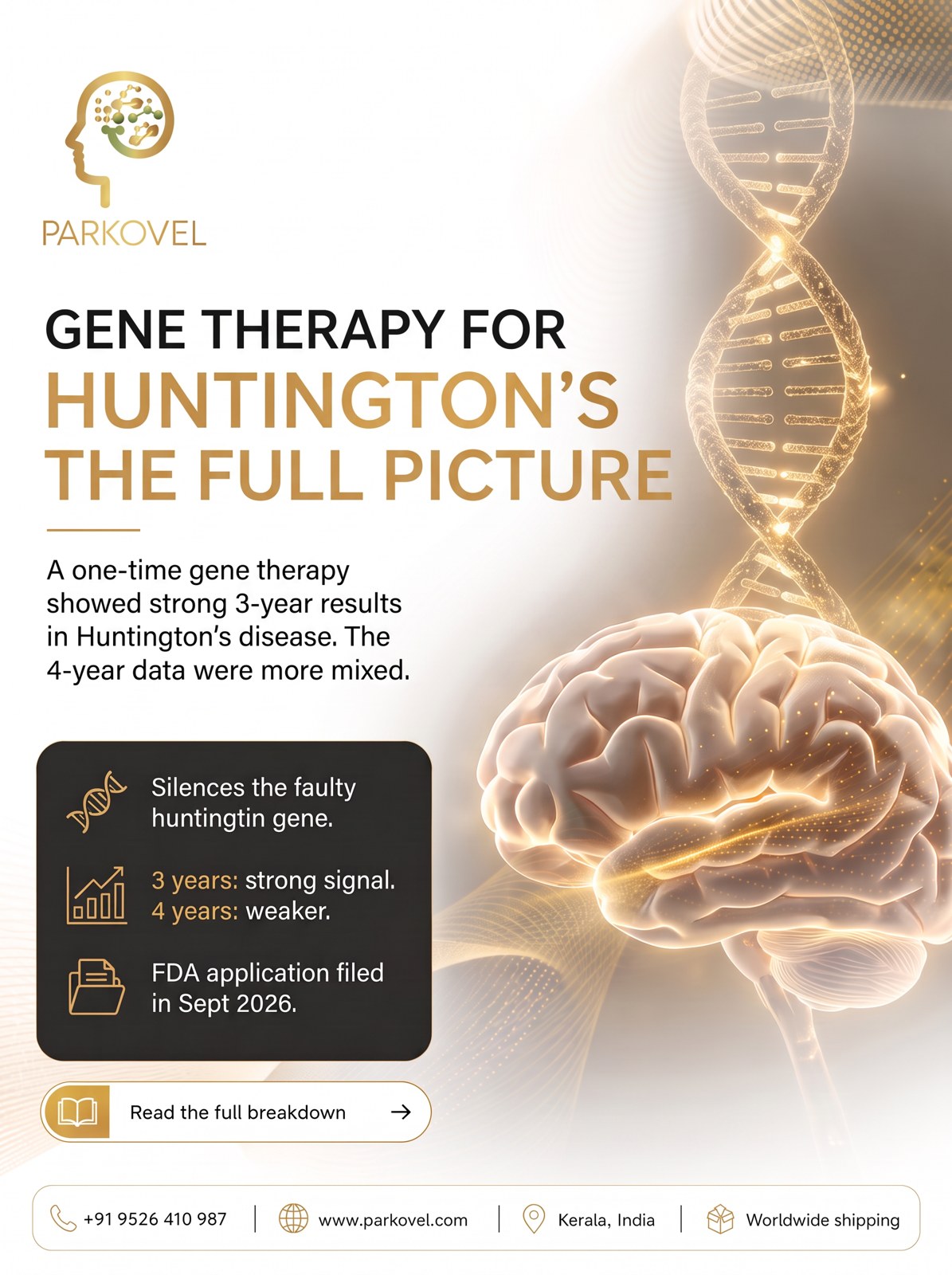
Huntington's disease is one of the cruellest neurodegenerative conditions: inherited, relentlessly progressive, and so far without any treatment that slows it. That's why results from uniQure's gene therapy AMT-130 drew worldwide attention. In a small trial, the highest dose appeared to slow disease progression substantially over three years. In September 2026, uniQure filed for US approval, and then released four-year data that were more mixed.
Huntington's in Brief
Huntington's is caused by an expanded stretch of DNA (a "CAG repeat") in the huntingtin gene. Each child of an affected parent has a 50% chance of inheriting it. The faulty gene produces a toxic form of the huntingtin protein that gradually destroys neurons, particularly in the striatum — the same deep brain region involved in Parkinson's. The result is involuntary movements, psychiatric symptoms and cognitive decline, usually starting in mid-adulthood.
How AMT-130 Works
AMT-130 is delivered once, through neurosurgery, directly into the striatum. It uses a harmless virus (AAV5) as a delivery vehicle to carry genetic instructions into brain cells. Those instructions make a small RNA molecule that silences the huntingtin gene, lowering production of the toxic protein. Because the instructions remain active in the cells, a single treatment is intended to work for years.
The Three-Year Results
In September 2025, uniQure reported three-year results. Twenty-nine patients were treated across low and high doses. Among 12 high-dose patients evaluated at 36 months, decline on the composite Unified Huntington's Disease Rating Scale (cUHDRS) was about 0.38 points, compared with 1.52 points in a matched external comparison group. That is roughly 75% slower progression. Levels of neurofilament light, a marker of nerve damage in spinal fluid, fell by an average of 8.2%. An updated three-year analysis released in September 2026 put the slowing at about 80% on the cUHDRS and 67% on Total Functional Capacity, a measure of everyday function. The therapy was described as generally well tolerated.
The Four-Year Update: A More Mixed Picture
On 29 September 2026, uniQure released 48-month data for the 12 high-dose patients. Slowing on the cUHDRS fell to 44% compared with an updated external control, and that difference was not statistically significant. Total Functional Capacity showed 61% slowing. After the company adjusted for missing data in the comparison group, the figures were 54% and 68%. uniQure's shares fell about 40% that day. The pattern could reflect a fading effect, the limits of external comparison groups, or both, and only further data will tell.
Where Approval Stands
The comparison groups in these analyses were external, drawn from natural-history studies rather than a placebo arm in the same trial, and the high-dose group was small. The full results have not yet been published in a peer-reviewed journal. The FDA's position on this design shifted during 2025. In June 2026, the agency indicated it would accept an accelerated-approval application based on the three-year data. uniQure submitted its Biologics License Application in early September 2026 and requested priority review. The four-year data were released after the filing. Submitting an application does not mean approval, and the FDA has not yet decided whether to accept or approve it.
Why Parkinson's Families Should Pay Attention
AMT-130 is one of the clearest demonstrations yet that a one-time gene-silencing therapy delivered to the brain may be able to slow a neurodegenerative disease, while also showing how hard such effects are to prove without a placebo group. Similar delivery technologies are being tested in Parkinson's, including gene therapies designed to protect or restore dopamine neurons. Progress in one disease often opens doors for the others.
Frequently Asked Questions
Is AMT-130 a cure for Huntington's?
No. It aims to slow progression, not reverse damage already done, and it has not been approved anywhere.
Is AMT-130 available in India?
No. It remains investigational, and any approval would begin in the United States.
Is Huntington's related to Parkinson's?
They are different diseases with different causes, but both damage movement circuits in the basal ganglia, and both are neurodegenerative.
Should at-risk family members get genetic testing?
Testing is a personal decision with major implications. It should be done with professional genetic counselling.
Sources
- uniQure, regulatory updates and BLA submission announcement for AMT-130 (2025–2026)
- uniQure, "AMT-130 September 2026 Data Update" (48-month results)
- BioPharma Dive, "UniQure tumbles with latest data for Huntington's gene therapy" (29 September 2026)
- HDBuzz, coverage of AMT-130 regulatory developments
- Clinical Trials Arena, "uniQure Huntington's disease AMT-130 Phase I/II" (September 2025)