Few herbs have made the leap from traditional Ayurvedic medicine to mainstream wellness shelves as completely as Ashwagandha (Withania somnifera). It's now backed by a genuinely substantial and growing body of modern research — not just as a general "stress herb," but as a compound with specific, mapped effects on the nervous system that matter for anyone managing a chronic neurological condition.
What Makes Ashwagandha Biologically Active
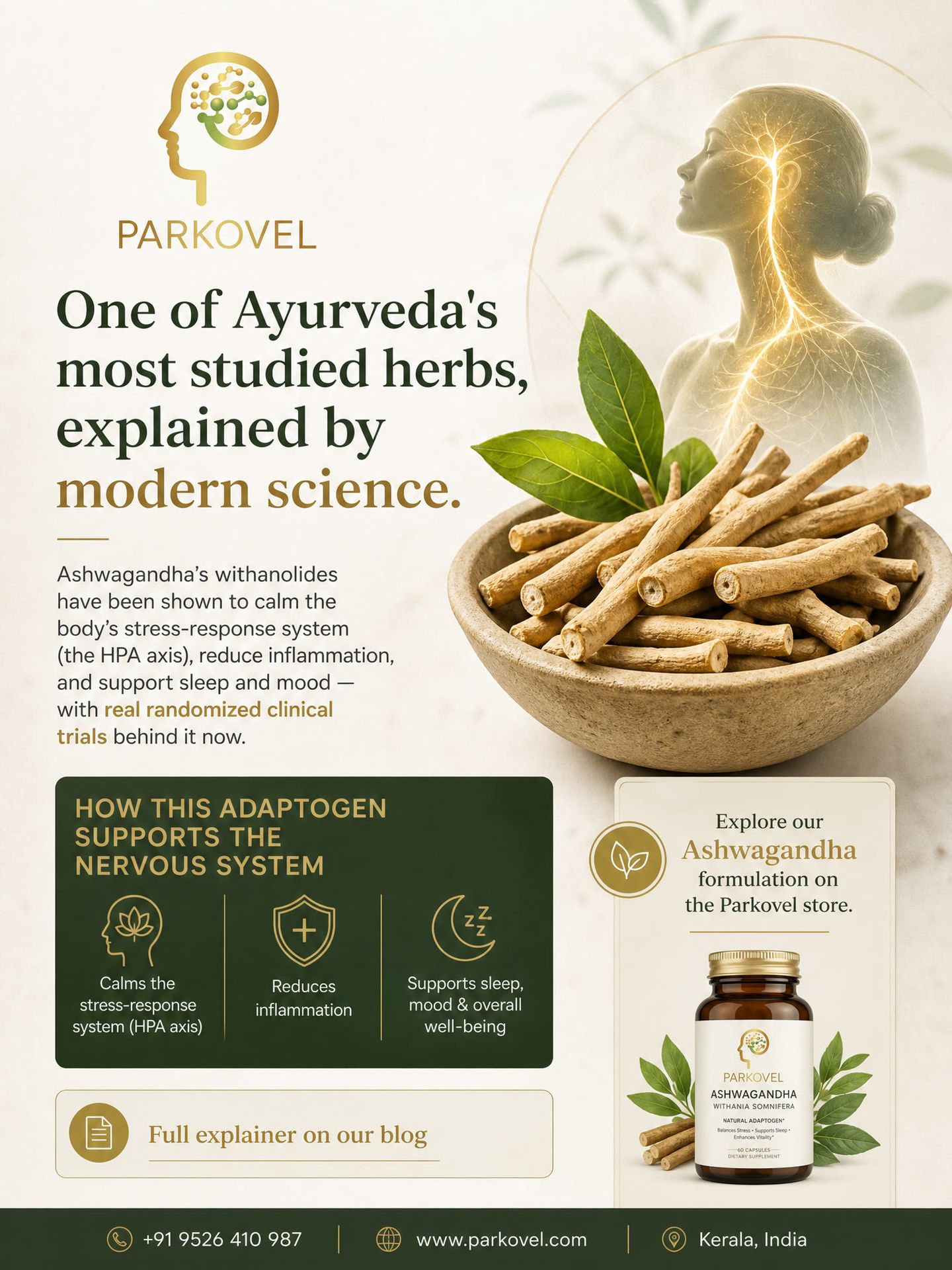
Ashwagandha's effects come primarily from steroidal lactones called withanolides, which include withanoside IV and V, withanolide A through D, withanone, and withaferin-A. These compounds are what researchers point to when explaining Ashwagandha's documented anti-oxidant, anxiolytic (anxiety-reducing), antidepressant, neuroprotective, and cognitive-enhancing properties — a wide-ranging profile for a single plant.
How It Works: The HPA Axis Connection
The mechanism is genuinely well-mapped compared to many traditional herbs. Ashwagandha's bioactive compounds modulate the hypothalamic-pituitary-adrenal (HPA) axis — the body's central stress-response system — while also inhibiting the inflammatory NF-κB pathway, activating the protective Nrf2 pathway, and affecting GABAergic signalling, the same neurotransmitter system targeted by many anti-anxiety medications. Together, these actions produce Ashwagandha's anti-inflammatory, antioxidant, and anxiolytic effects, giving it a credible biological basis rather than relying purely on traditional reputation.
What Clinical Trials Show
Clinical trials using standardised Ashwagandha extracts have shown reductions in stress-related biomarkers, alongside improvements in cognitive performance, sleep quality, and mood parameters. A 2025 randomised, double-blind, placebo-controlled study of a novel Ashwagandha formulation found it alleviated stress and anxiety symptoms while improving both mood and sleep quality — the kind of rigorous trial design that gives real weight to traditional herbal claims. Separate animal research has shown Ashwagandha formulations can mitigate cognitive impairment and oxidative stress caused by sleep deprivation, connecting the herb's stress-modulating effects directly to measurable brain protection.
Why This Matters for Neurological Conditions
Chronic stress and elevated cortisol are increasingly implicated in worsening neuroinflammation — a process relevant across many neurodegenerative conditions, including Parkinson's disease, where oxidative stress and inflammation are known contributors to ongoing neuron loss. Ashwagandha's documented ability to calm the HPA axis and reduce inflammatory signalling is why it's frequently studied and used as a complementary support for the nervous system, alongside — never instead of — primary medical treatment.
An Honest Caveat
Most of Ashwagandha's most specific mechanistic research comes from broader neurological and stress-related studies rather than large-scale human trials in Parkinson's disease patients specifically. Its role in Parkinson's care today is best understood as general nervous system and stress support — genuinely evidence-backed for that purpose — rather than as a targeted Parkinson's treatment with dedicated large-scale trials behind it, the way Mucuna Pruriens increasingly has.
Frequently Asked Questions
Is Ashwagandha safe to take alongside Parkinson's medication?
Ashwagandha is generally well-tolerated in studied doses, but anyone on Parkinson's medication or other prescriptions should check with their doctor before adding any supplement, since individual interactions can vary.
How long does Ashwagandha take to show an effect on stress or sleep?
Clinical trials have shown measurable improvements in stress and sleep markers within several weeks of consistent use with standardised extracts, though individual response varies.
Does Ashwagandha directly treat Parkinson's motor symptoms?
No — its evidence base is strongest for stress reduction, anxiety, sleep quality, and general neuroprotective support, not for directly treating Parkinson's motor symptoms like tremor or rigidity.
What's the difference between Ashwagandha and Mucuna Pruriens in Ayurvedic Parkinson's care?
They serve different roles: Mucuna Pruriens is studied specifically for its natural L-dopa content relevant to Parkinson's motor symptoms, while Ashwagandha is studied primarily for stress-axis regulation and general nervous system resilience — complementary rather than interchangeable.
Many families managing Parkinson's use Ashwagandha alongside Mucuna Pruriens-based formulations like Parkovel365 as part of a broader Ayurvedic wellness routine — always in consultation with a treating physician who knows the person's full medication picture.
Sources
- PMC/Cureus, "Ashwagandha as an Adaptogenic Herb: A Comprehensive Review of Immunological and Neurological Effects"
- Springer, "A New Ashwagandha Formulation (Zenroot™) Alleviates Stress and Anxiety Symptoms While Improving Mood and Sleep Quality: A Randomized, Double-Blind, Placebo-Controlled Clinical Study" (2025)
- PMC, "A Novel Ashwagandha (Withania somnifera) Formulation Mitigates Sleep Deprivation-Induced Cognitive Impairment and Oxidative Stress in a Rat Model"