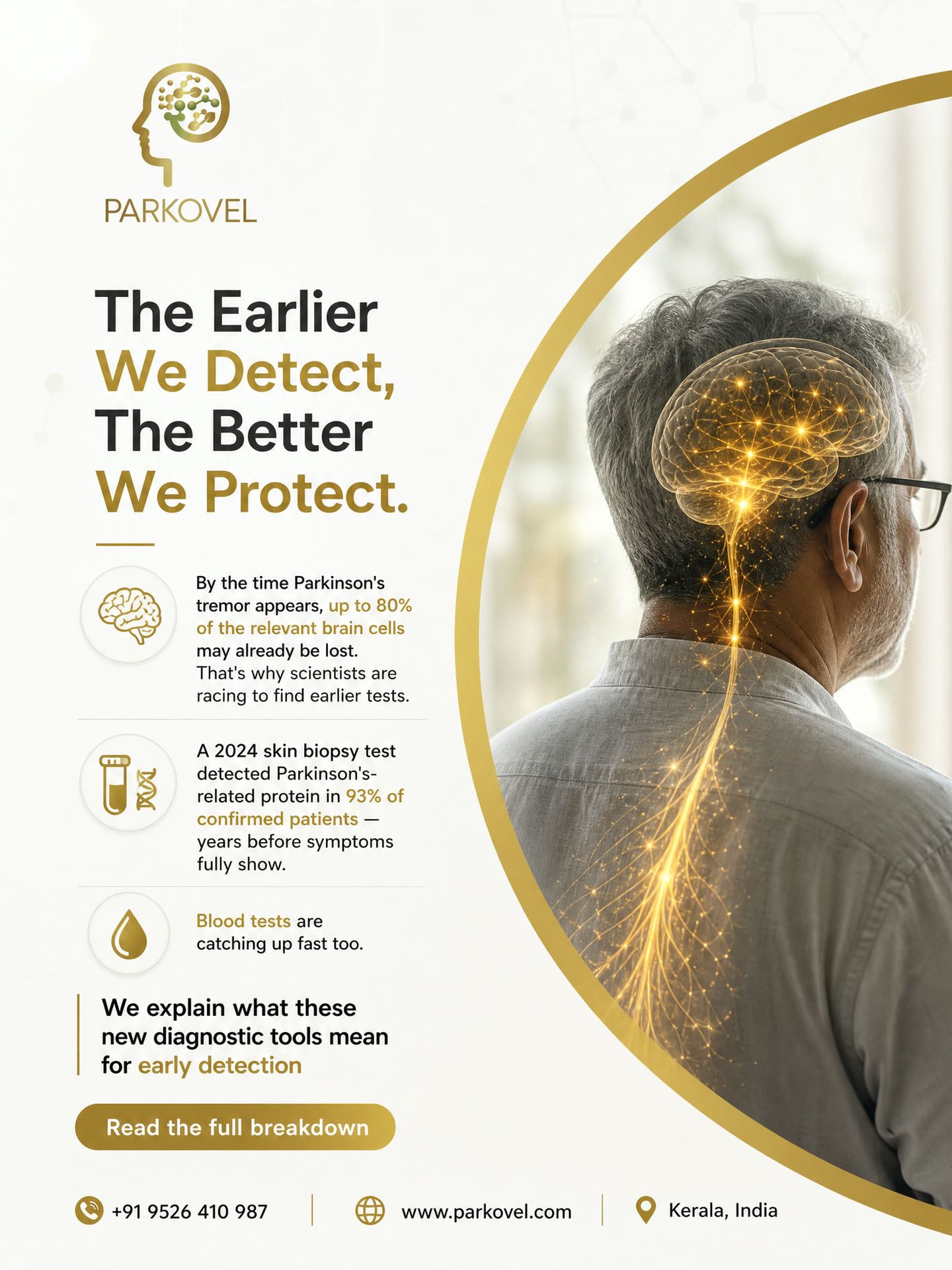
For over 200 years, Parkinson's disease has been diagnosed the same way: a clinician watches how a person moves, checking for tremor, stiffness, and slowness, because there has been no simple lab test to confirm it. That is finally starting to change, and the shift matters enormously — by the time visible motor symptoms appear, a person has often already lost 50-80% of the dopamine-producing neurons in the affected brain region.
Why a Simple Test Has Been So Hard to Find
Parkinson's disease is driven by misfolded alpha-synuclein protein clumping inside neurons. The trouble is, brain tissue can't easily be sampled in a living patient, so researchers have spent decades searching for signs of this same misfolded protein somewhere more accessible — the skin, the blood, spinal fluid, even the gut.
The Skin Biopsy Breakthrough
One of the most validated advances is a small skin biopsy test that detects phosphorylated alpha-synuclein (P-SYN), the misfolded form of the protein associated with Parkinson's. In a landmark study reported in the Journal of the American Medical Association in March 2024, P-SYN was found in 93% of people with clinically confirmed Parkinson's disease (89 of 96 participants). The procedure itself is minimally invasive: small 3mm skin samples are taken from three sites — typically the neck, knee, and ankle.
Blood Tests Are Catching Up
Blood tests remain earlier-stage but are advancing quickly. They are attractive because they are minimally invasive, relatively inexpensive, and could potentially be used for widespread screening — something a skin biopsy or spinal tap could never realistically achieve at population scale. A 2025 study published in npj Parkinson's Disease examined multiplex blood and urine biomarkers that could flag Parkinson's-related changes prior to a clinical diagnosis, while separate 2025 research has explored RNA-based blood tests as another promising avenue.
What "Earlier Diagnosis" Actually Changes
An earlier, more certain diagnosis does three concrete things: it lets patients start supportive therapies (exercise, speech therapy, dietary changes) before major neuron loss occurs, it opens the door to future disease-modifying drug trials that need to enroll patients at the earliest possible stage, and it removes the anxiety of a prolonged, ambiguous diagnostic journey that many Parkinson's patients currently experience.
Where This Stands Today
None of these tests have yet fully replaced clinical evaluation by a neurologist, and none are part of routine screening for the general population. They are most useful currently in research settings, in confirming a diagnosis that is clinically uncertain, and in identifying Parkinson's-related conditions like REM sleep behavior disorder before full motor symptoms emerge.
Frequently Asked Questions
Can I get a skin or blood test for Parkinson's in India right now?
Availability is limited and largely concentrated in specialised research hospitals and select movement disorder centres; it is not yet a routine diagnostic offered everywhere. Ask a neurologist at a major academic medical centre about current options.
Does a positive P-SYN skin test mean I will definitely develop Parkinson's?
Not necessarily on its own — it indicates the presence of the misfolded protein associated with Parkinson's and related conditions, but interpretation still requires a specialist alongside clinical evaluation.
How is this different from a DAT scan?
A DAT (dopamine transporter) scan is an imaging test that's been used for years to support a Parkinson's diagnosis by visualising dopamine activity in the brain. Skin and blood biomarker tests are newer, less invasive, and look at different underlying biology — the alpha-synuclein protein itself.
Early recognition matters for another reason too: it's the window in which natural and lifestyle-based support — from targeted Ayurvedic formulations to structured exercise — tend to have the most room to help. Anyone noticing early or unexplained motor changes should see a neurologist for proper evaluation rather than self-diagnosing from a blog post.
Sources
- NIH Research Matters, "Skin test detects evidence of Parkinson's and related disorders" (JAMA, March 2024)
- npj Parkinson's Disease, "Early detection of Parkinson's disease through multiplex blood and urine biomarkers prior to clinical diagnosis" (2025)
- Frontiers in Aging Neuroscience, "Early diagnosis of Parkinson's disease: biomarker study" (2025)