Most Parkinson's cases are not caused by a single gene. Researchers increasingly believe the disease arises from a mix of ageing, genetic susceptibility, and environmental exposures built up over decades. Among those exposures, pesticides have drawn sustained attention — and a major study from UCLA Health has added some of the strongest evidence yet against one widely used insecticide: chlorpyrifos.
What the Study Found
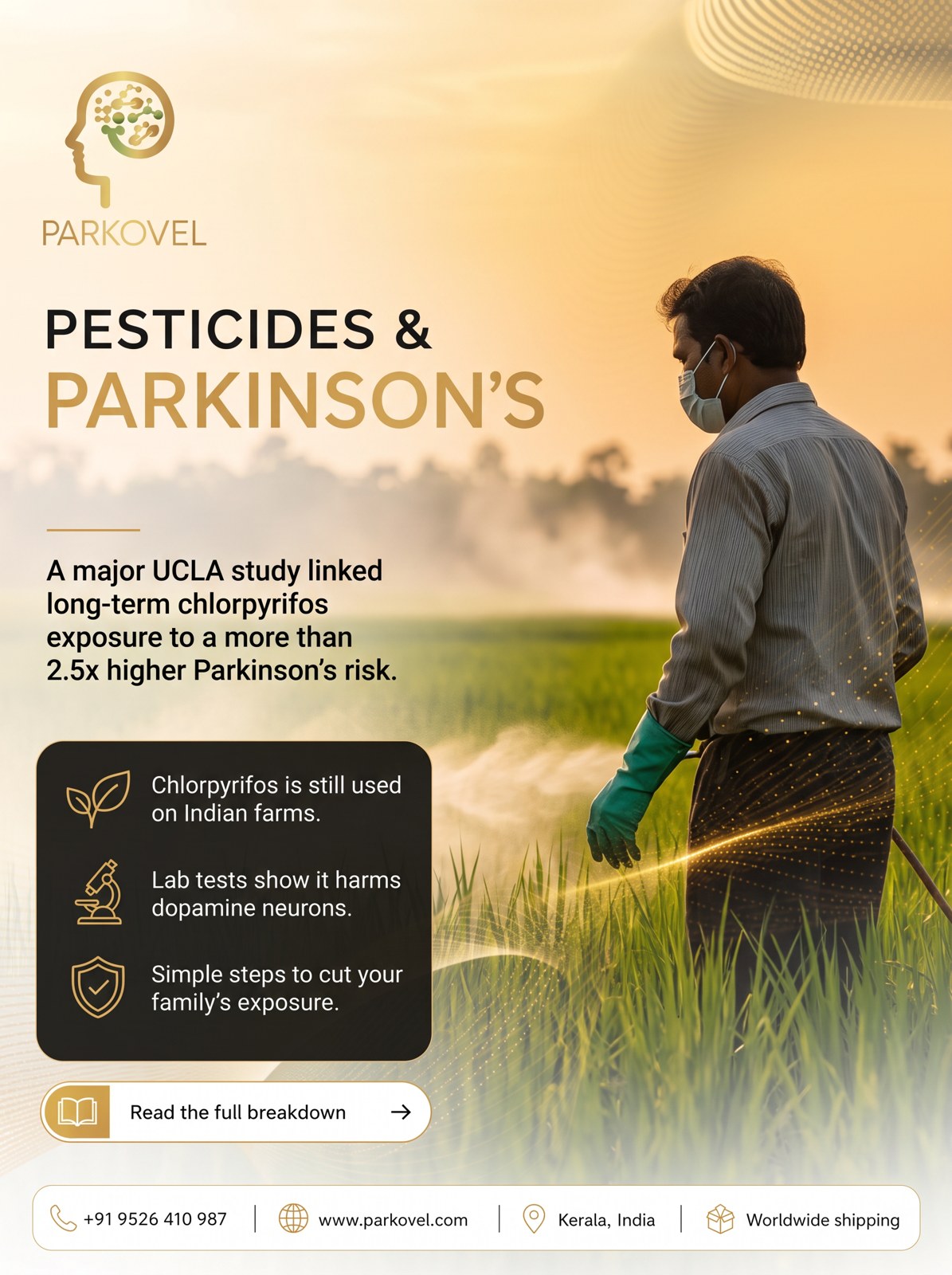
The UCLA team drew on the Parkinson's Environment and Genes (PEG) study, which compared 829 people with Parkinson's and 824 people without it in three farming counties of California's Central Valley. Using detailed records of where pesticides were applied and where participants lived and worked, the researchers found that long-term exposure to chlorpyrifos near the home was associated with a more than 2.5-fold higher risk of developing Parkinson's. They adjusted for other pesticide exposures, including paraquat, glyphosate, and diazinon.
The team didn't stop at statistics. In laboratory experiments, chlorpyrifos exposure caused movement problems in animals, killed dopamine-producing neurons, and interfered with autophagy — the process cells use to clear out damaged proteins. The result was a build-up of the same toxic alpha-synuclein protein found in human Parkinson's. The findings were published in Molecular Neurodegeneration on 11 December 2025, and UCLA publicised them in January 2026.
The "more than 2.5-fold" figure applies specifically to long-term residential exposure in this Californian population. It is not a risk estimate for every kind of exposure, and no equivalent study has yet measured the risk in India.
Association, Not Proof — But a Consistent Pattern
A population study like this shows association, not definitive cause. But when human data and laboratory mechanisms point the same way, the case becomes considerably stronger. It also fits a wider pattern: earlier research has tied other agricultural chemicals, such as paraquat and rotenone, to higher Parkinson's risk.
Why This Matters in India
Chlorpyrifos remains registered in India and is used on crops including rice, cotton, groundnut and vegetables. In 2023, its use was barred on ber, citrus and tobacco, and Punjab has restricted it on paddy because of residue problems in exported basmati. Internationally, the chemical was listed under the Stockholm Convention in 2025 with a five-year exemption that India supported, and the European Union's ban took effect on 30 September 2026.
For India's large farming population, that means exposure is still a practical reality, especially for those who mix and spray pesticides, and for families living close to sprayed fields.
Practical Steps to Reduce Exposure
- Use gloves, masks, full sleeves and eye protection when mixing or spraying any pesticide, and wash and change immediately afterwards.
- Store chemicals away from living and cooking areas, and never reuse pesticide containers.
- Wash fruits and vegetables thoroughly under running water; peeling can reduce surface residues further.
- Keep children and older family members away from fields during and just after spraying.
- Ask local agricultural officers about safer alternatives and integrated pest management.
Frequently Asked Questions
Does eating vegetables sprayed with chlorpyrifos cause Parkinson's?
The study looked at long-term residential and occupational exposure, not food residues. Washing produce well is still a sensible precaution.
Is chlorpyrifos banned in India?
No, it is restricted on certain crops but not banned outright. Some states have added their own restrictions.
Can avoiding pesticides prevent Parkinson's?
No single step can guarantee prevention, but reducing avoidable chemical exposure is a reasonable way to lower one known risk factor.
I worked with pesticides for years. Should I be worried?
Exposure raises risk but does not mean you will develop Parkinson's. Watch for early signs such as loss of smell, constipation, acting out dreams, or a slight tremor, and discuss them with a doctor.
For Parkovel, rooted in Kerala's agricultural heartland, this research is a reminder that brain health starts with the environment we live in — as well as the food, movement and care we choose every day.
Sources
- Molecular Neurodegeneration, chlorpyrifos exposure and Parkinson's disease risk, PEG study (11 December 2025)
- UCLA Newsroom, "Widely used pesticide linked to more than doubled Parkinson's risk" (January 2026)
- PPQS, Government of India, list of pesticides banned, refused registration and restricted in use
- Medical Dialogues, "Widely used pesticide linked to more than doubled Parkinson's risk, finds study" (2026)
- Down To Earth, coverage of India's position on chlorpyrifos at the Stockholm Convention (2025)