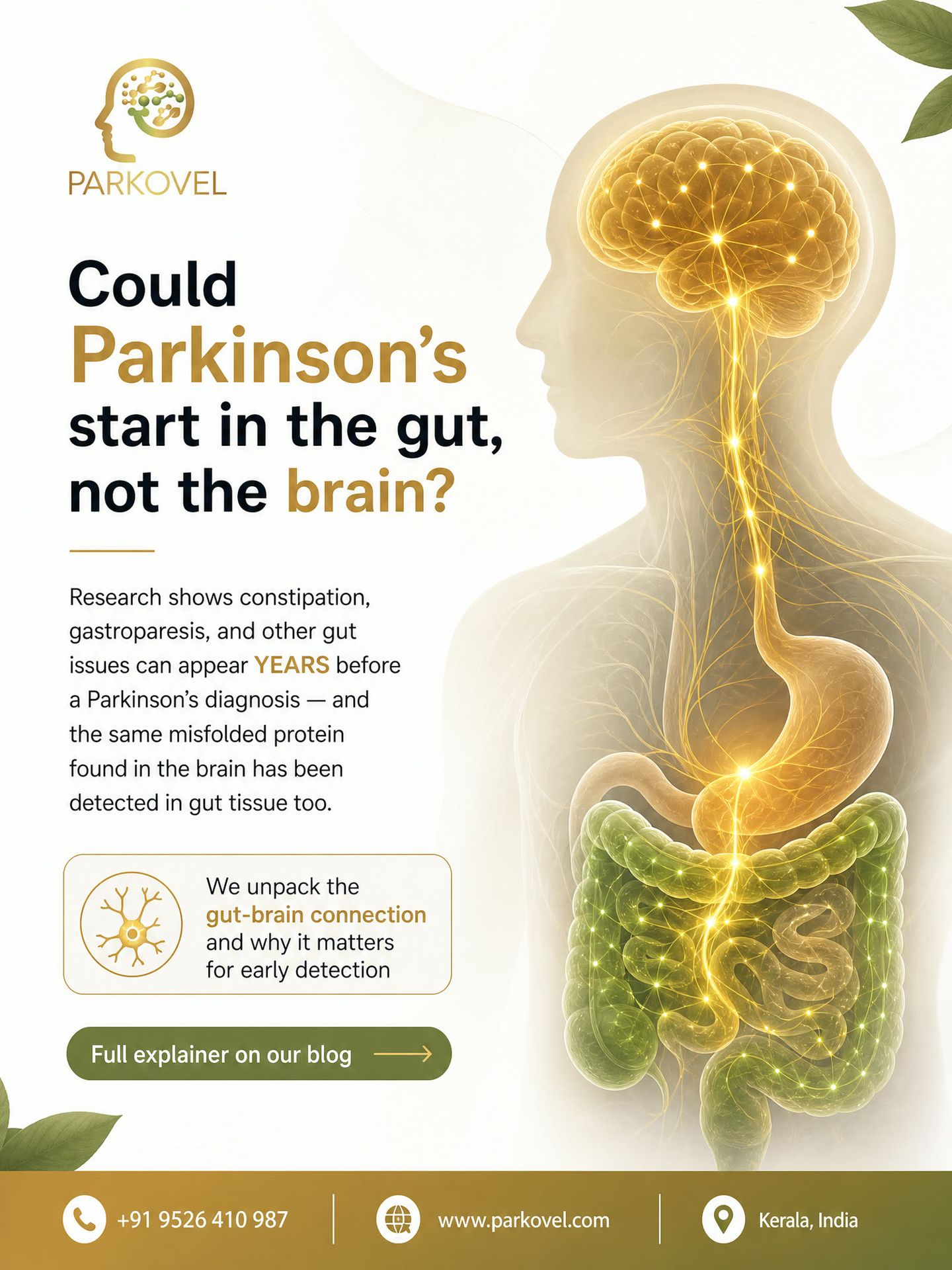
If someone had to guess where Parkinson's disease begins, most people would say the brain. A growing body of research suggests that for many patients, it may actually begin much closer to the gut — and that ordinary, easily-dismissed constipation can be one of the earliest detectable signs of the disease, sometimes appearing decades before a tremor.
More Than an Uncomfortable Coincidence
Gastrointestinal symptoms, particularly constipation, are among the most prominent and troublesome early manifestations of Parkinson's disease. It's recognised as one of several prodromal (pre-diagnosis) symptoms, alongside loss of sense of smell, REM sleep behavior disorder, and anxiety or depression — a cluster of seemingly unrelated symptoms that researchers now understand share a common underlying cause.
Not Just Constipation — A Wider Gut Pattern
Recent research has broadened the picture beyond constipation alone. A large study found that gastroparesis (delayed stomach emptying), dysphagia (difficulty swallowing), and constipation were all associated with more than double the risk of a Parkinson's diagnosis in the five years that followed, while irritable bowel syndrome without diarrhoea carried a 17% higher risk. This isn't a minor statistical footnote — it's one of the more consistent findings in modern Parkinson's research.
The Biological "Why": Parkinson's May Start in the Gut
The explanation lies in alpha-synuclein, the misfolded protein at the centre of Parkinson's pathology. Alpha-synuclein aggregations can be found in the gastrointestinal tract of patients with early or even prodromal Parkinson's disease, lending real weight to the theory that Parkinson's disease may start in the gut, at least in some patients, before spreading along nerve pathways toward the brain. Supporting this, researchers have found that people with constipation showed significantly greater evidence of central nervous system inflammation than those without — suggesting the same inflammatory processes suspected of damaging brain neurons may also be at work in the gut, very early in the disease process.
Why This Matters for Disease Course, Not Just Diagnosis
The gut connection isn't only about early detection. Research has also found that early constipation may predict an accelerated progression of neurodegenerative pathology overall, including a faster onset of dementia-related complications later in the disease. This makes gut health an active area of ongoing management, not just a historical clue.
What This Means in Practice
Chronic constipation, especially when it appears alongside other prodromal signs like reduced sense of smell or vivid, physically-acted-out dreams, is worth mentioning to a doctor — not as a cause for alarm, but as a piece of a bigger picture that a neurologist can help interpret. For people already diagnosed with Parkinson's, proactively managing gut health — through fibre, hydration, movement, and in some cases the Mediterranean-style dietary approaches covered elsewhere on this blog — remains one of the most practical, low-risk parts of a daily care routine.
Frequently Asked Questions
Does having constipation mean I will get Parkinson's disease?
No — constipation is extremely common and has many causes. It becomes clinically significant as a Parkinson's-related sign mainly when it's chronic and appears alongside other prodromal symptoms like smell loss or REM sleep behavior disorder.
Can improving gut health slow Parkinson's progression?
Some research suggests gut inflammation may be linked to disease progression, but there's no proven intervention yet that reverses Parkinson's through gut treatment alone. Good gut health remains a sensible, low-risk part of overall management.
Why does Parkinson's cause constipation in the first place?
Parkinson's affects the autonomic nervous system, which controls involuntary gut movement, and alpha-synuclein deposits in the gut's own nerve network are believed to disrupt normal digestive motility.
Should I see a gastroenterologist or a neurologist about persistent constipation?
Start with your primary doctor, who can rule out common causes and refer you appropriately — either to a gastroenterologist for the constipation itself or a neurologist if other prodromal signs are also present.
Sources
- Parkinson's UK / BMJ Group, "Certain gut conditions may be an early sign of Parkinson's" (2023)
- American Parkinson Disease Association, "Constipation in Early Parkinson's Disease is Linked to Neuroinflammation"
- PMC, "Early constipation predicts faster dementia onset in Parkinson's disease"