Turmeric has flavoured Indian kitchens for thousands of years, but in the last two decades it has also become one of the most heavily studied natural compounds in neurodegenerative disease research. Curcumin, the yellow-pigmented polyphenol responsible for turmeric's colour, is now the subject of dozens of laboratory studies examining exactly how it might protect the brain's dopamine-producing neurons — the cells that Parkinson's disease destroys.
A Curious Epidemiological Clue
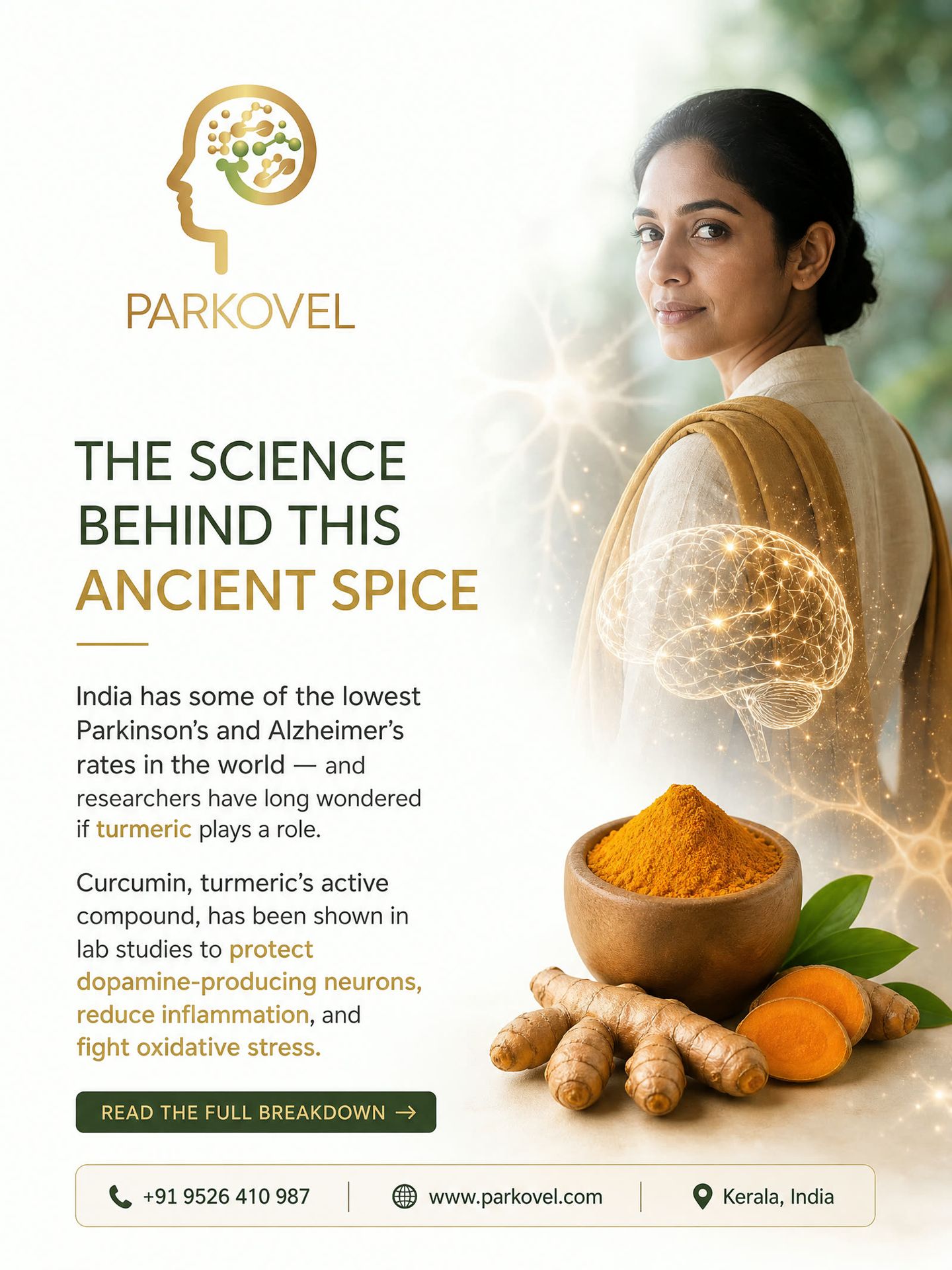
One of the observations that first drew researchers' attention: epidemiological evidence from India has linked high dietary turmeric consumption to some of the lowest recorded prevalence rates of both Alzheimer's and Parkinson's disease in the world. Correlation isn't proof, but it was enough to send curcumin research into overdrive.
How Curcumin Appears to Protect Neurons
Curcumin's protective mechanisms have now been mapped across several biological pathways. As a potent antioxidant, it scavenges reactive oxygen species and chelates toxic metals — both implicated in the oxidative damage seen in Parkinson's-affected brain tissue. In animal models, curcumin treatment has been shown to significantly improve abnormal motor behaviour and protect against the loss of dopaminergic neurons.
More recent mechanistic research has gone further: curcumin appears to block a specific inflammatory pathway (the HDAC6–NLRP3 pathway) implicated in neurodegeneration, mitigating the inflammatory response associated with Parkinson's both in laboratory cell cultures and in animal studies. Separately, curcumin has been shown to regulate signalling pathways that reduce oxidative stress, decrease neuroinflammation, and enhance autophagy — the cell's internal "clean-up" process that clears damaged proteins, including the misfolded alpha-synuclein central to Parkinson's pathology.
From Lab Bench to Human Benefit: The Honest Gap
Here is the important caveat that any credible source has to include: nearly all of this evidence comes from cell cultures and animal models, not large human clinical trials. Curcumin is emerging as a promising candidate for adjuvant (supportive, add-on) therapy in Parkinson's disease, but "promising candidate" is scientific language for "worth studying further," not "proven treatment." A major practical obstacle is curcumin's notoriously poor bioavailability — the body absorbs very little of it when eaten plain, which is why traditional Ayurvedic and modern supplement formulations typically combine turmeric with black pepper (piperine) or fat to dramatically improve absorption.
Where Curcumin Fits Today
Given the strength of the mechanistic evidence and turmeric's centuries-long safety record in food and Ayurvedic medicine, many neurologists see no harm in incorporating turmeric into a balanced diet as part of general brain-supportive nutrition. It should be understood as a complementary, food-based habit — not a replacement for prescribed Parkinson's medication or a stand-alone treatment.
Frequently Asked Questions
Can eating turmeric replace Parkinson's medication?
No. Curcumin research is still largely preclinical (lab and animal studies). It should never replace levodopa or other prescribed treatment.
Why is curcumin often paired with black pepper?
Piperine, the active compound in black pepper, can increase curcumin's bioavailability significantly, since curcumin alone is poorly absorbed by the digestive system.
Is turmeric safe to take alongside Parkinson's medication?
Turmeric used as a culinary spice is generally considered safe, but concentrated curcumin supplements can interact with certain medications (including blood thinners), so it's worth checking with a doctor before starting high-dose supplements.
Does India's turmeric-heavy diet really lower Parkinson's risk?
The epidemiological association is real and intriguing, but it hasn't been proven as a direct cause-and-effect relationship — diet, genetics, and lifestyle all differ across populations being compared.
Turmeric's story is a good reminder of how Ayurvedic ingredients are increasingly being validated by modern laboratory science — much like Mucuna Pruriens, the basis of Parkovel365, which has its own growing body of clinical research behind it.
Sources
- PMC, "Neuroprotective Activities of Curcumin in Parkinson's Disease: A Review of the Literature"
- ScienceDirect, "Curcumin prevents neurodegeneration by blocking HDAC6–NLRP3 pathway-dependent neuroinflammation in Parkinson's disease" (2024)
- PMC, "An Overview of Parkinson's Disease: Curcumin as a Possible Alternative Treatment"