For people whose Parkinson's medicines no longer give smooth, predictable control, the main surgical option for years has been deep brain stimulation (DBS), which involves implanting electrodes and a battery. Magnetic resonance-guided focused ultrasound (MRgFUS) offers a different path: no incision, no implant. A multi-centre trial published in The Lancet Neurology in July 2026 gives the clearest picture yet of what it can — and can't — do when used on both sides of the brain.
How Focused Ultrasound Works
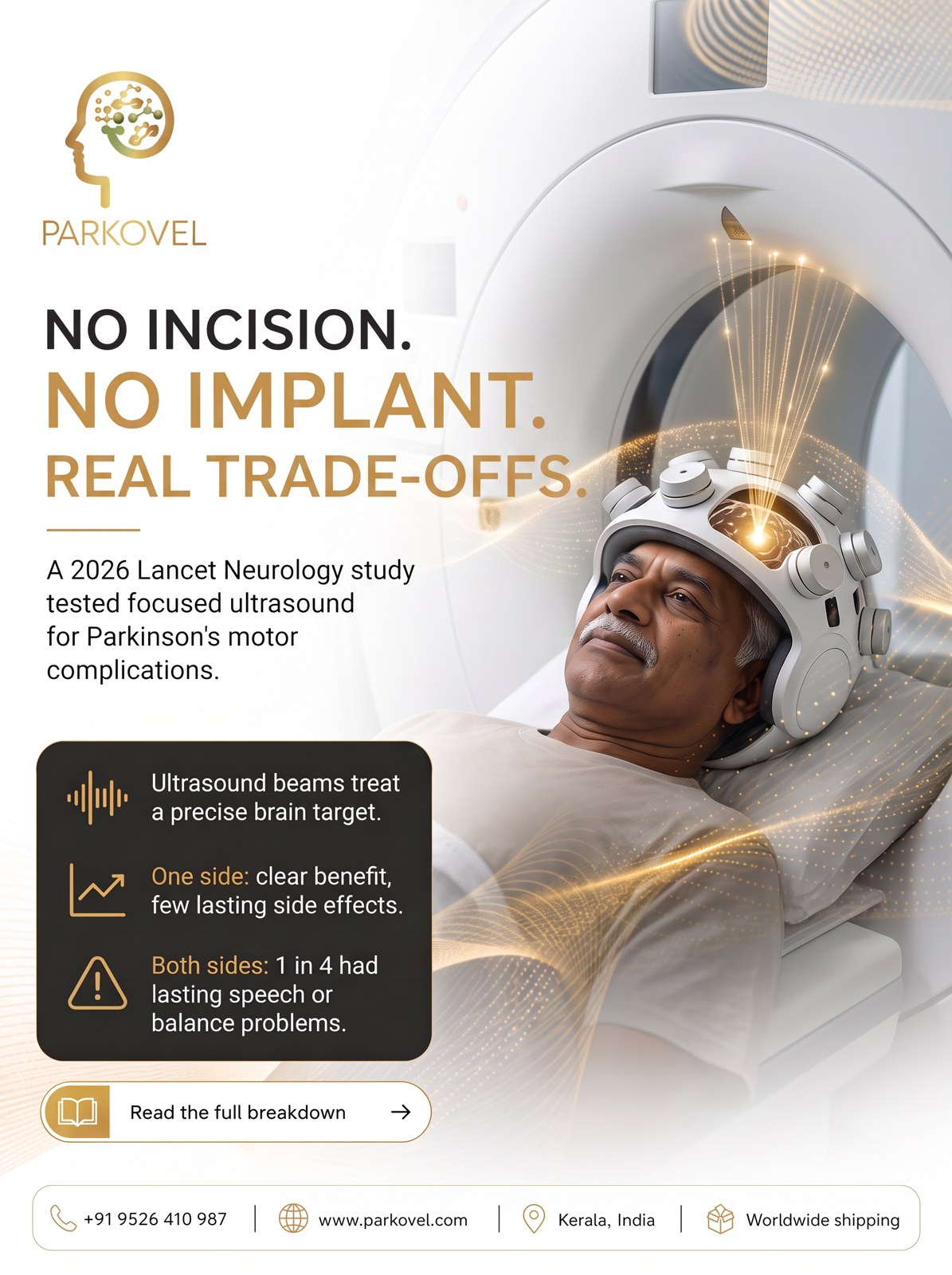
The patient lies in an MRI scanner wearing a helmet-like device containing hundreds of ultrasound sources. Each beam is harmless on its own, but where they converge deep in the brain they create enough heat to make a tiny, precise lesion in a target that's driving abnormal movement signals. The MRI lets doctors see the target in real time and test the effect before making the lesion permanent. There's no cut in the skin and no hardware left behind.
What the 2026 Trial Tested
The study treated a target called the pallidothalamic tract in people with advanced Parkinson's who had motor fluctuations and dyskinesia. Fifty-four patients across nine centres had one side treated first; 40 then went on to have the second side treated in a later, "staged" procedure. They were followed for 12 months after the second treatment.
The Results
The trial's main measure was the off-medication motor score for the arms and legs. Three months after the second procedure, it improved by a median of 32%, a statistically significant change. Benefits appeared within a month of the first treatment and lasted through 12 months after the second. The manufacturer's announcement also highlighted an improvement of about two-thirds in motor complications, but the 32% figure is the study's prespecified primary result.
The safety picture was more mixed. After treating one side, 39% of patients had a treatment-related side effect, and only one had a persistent moderate problem at six months. After the second side was treated, 55% had treatment-related side effects, and 25% (10 of 40) still had moderate or severe problems at 12 months, mainly affecting speech, walking and balance. One patient developed severe, lasting loss of speech. The authors concluded that one-sided treatment was safe and effective, but that the second side "offered small motor gains while increasing persistent moderate or severe adverse events." An independent UK expert commented that bilateral focused ultrasound should not yet be adopted in routine practice.
Context You Should Know
The trial was funded by Insightec, the manufacturer of the ultrasound system, and it had no control group. The journal published a correction to the paper in October 2026, so readers checking figures should use the corrected version. The data supported the US FDA's approval of staged bilateral focused ultrasound for advanced Parkinson's with motor fluctuations and dyskinesia. Lesions are permanent, unlike DBS, which can be adjusted or switched off. For many patients, the choice between the two is a careful trade-off that should be made with an experienced movement-disorder team.
Frequently Asked Questions
Is focused ultrasound better than deep brain stimulation?
Not universally. Focused ultrasound avoids implants and open surgery, but its lesions can't be adjusted, and bilateral treatment carries a notable side-effect risk. DBS is adjustable and reversible. The right option depends on the individual.
Does it cure Parkinson's?
No. It treats specific motor symptoms and complications. The underlying disease continues, and most patients remain on medication.
Is focused ultrasound available in India?
A small number of Indian centres have MRgFUS systems, mostly used for tremor. Ask a movement-disorder neurologist about availability and suitability.
Who is a candidate?
Typically people with established Parkinson's whose medication response is good but whose motor fluctuations or dyskinesia are hard to control — evaluated by a specialist team.
Procedures address specific symptoms; long-term wellbeing still rests on medication, therapy, nutrition and supportive care. Families exploring Ayurvedic support such as Parkovel365 should coordinate it with the treating neurologist.
Sources
- Dalvi A, et al., "Safety and efficacy of staged, bilateral magnetic resonance-guided focused ultrasound pallidothalamic tractotomy for motor complications of Parkinson's disease," The Lancet Neurology 25(7):654–663, July 2026; correction in 25(10):e14, October 2026
- NeurologyLive, "Focused Ultrasound vs DBS in Parkinson Disease: What New Bilateral Data Tell Us" (July 2026)
- Insightec, press release on the Lancet Neurology study (June 2026)