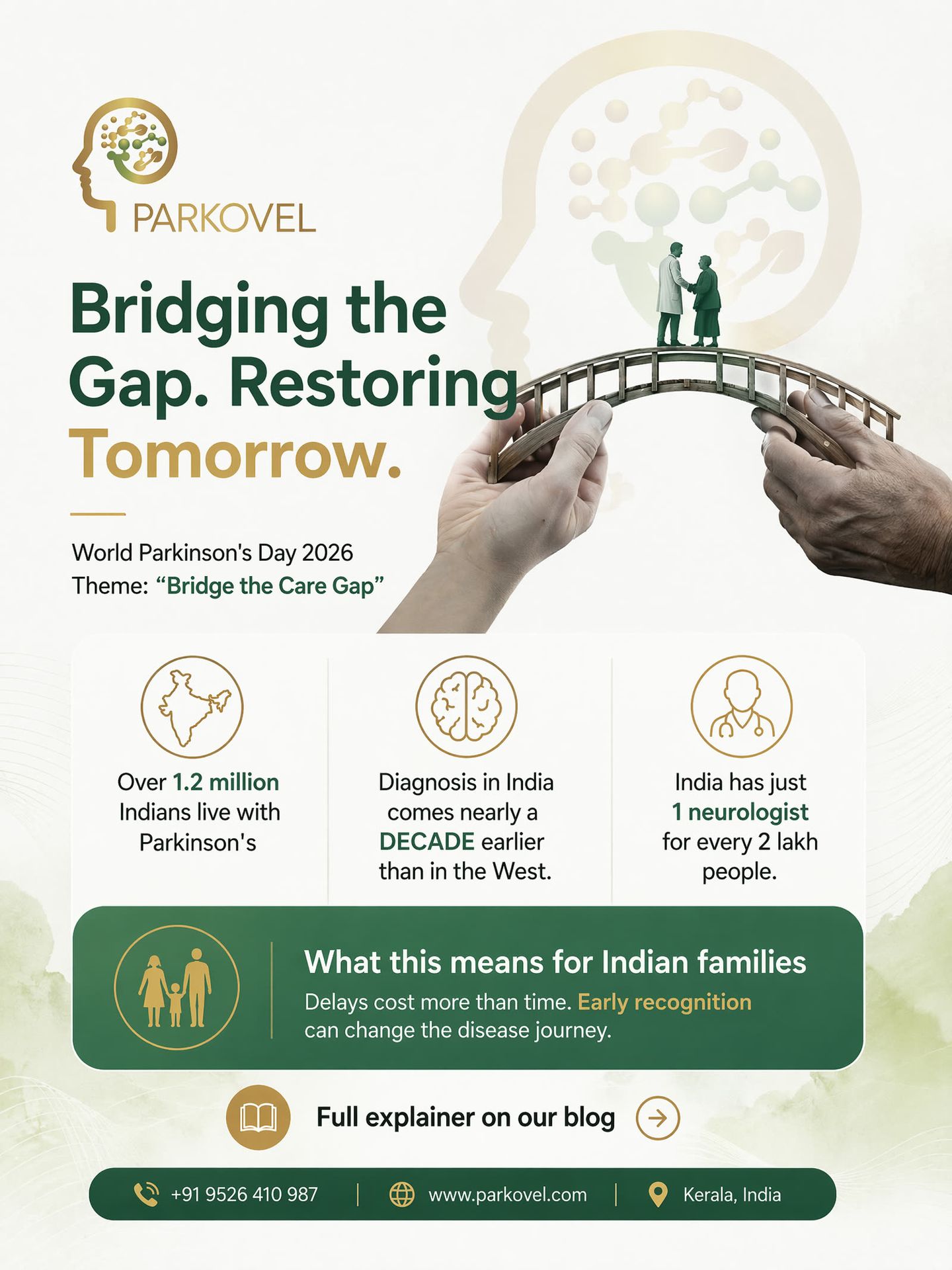
World Parkinson's Day falls on April 11 every year, marking the birthday of Dr. James Parkinson, who first clinically described the condition in 1817. The 2026 global theme, "Bridge the Care Gap," could not be more directly relevant to India, where the disease's clinical profile and the country's healthcare infrastructure create a uniquely challenging combination.
The Scale of the Problem in India
Over 1.2 million people in India are living with Parkinson's disease, according to recent estimates — a substantial and likely undercounted figure, given how much epidemiological research on Parkinson's in India remains limited compared to Western countries. Globally, the picture is growing more urgent too: Parkinson's prevalence has risen 21.7% over the past two decades, and projections suggest the worldwide total could climb from roughly 10 million today to 25 million by 2050, driven primarily by an ageing global population.
India's Distinctly Younger Disease Profile
Perhaps the most striking Indian-specific finding comes from a 2025 nation-wide multicenter study: the mean age of Parkinson's onset in India is nearly a decade earlier than in European, African, and East Asian populations, though similar to patterns observed in Latin America. Over 40 to 50% of India's Parkinson's cases are diagnosed in people between the ages of 20 and 50 — a demographic reality that reshapes what "typical" Parkinson's care needs to look like in India, factoring in careers, young families, and decades-long treatment horizons that Western care models weren't originally designed around.
Interestingly, the same research found that the clinical characteristics, environmental exposures, habits, and comorbid conditions associated with Parkinson's in India were broadly similar to those seen in European populations — suggesting the earlier onset age isn't necessarily explained by a fundamentally different disease, but by factors researchers are still working to fully identify.
The Care Gap, In Concrete Numbers
The "Bridge the Care Gap" theme reflects a genuine structural problem. In India, there is roughly one neurologist for every 2 lakh (200,000) people, and the bulk of them — 70 to 80% — practise in cities, leaving vast rural populations with minimal specialist access. For a progressive condition where early diagnosis and prompt physiotherapy referral are now globally recommended standards of care, this access gap translates directly into delayed diagnosis, delayed treatment, and worse long-term outcomes for a large share of India's Parkinson's population.
What "Bridging the Gap" Looks Like in Practice
Awareness campaigns around World Parkinson's Day tend to focus on three practical levers: earlier recognition of symptoms — including the non-motor and prodromal signs covered elsewhere on this blog, like sleep changes, constipation, and mood shifts — so families seek care sooner rather than waiting for tremor to become obvious; wider availability of telemedicine and outreach clinics to partially offset the urban-rural neurologist imbalance; and community-level education, since Parkinson's is still frequently mistaken for normal ageing in India, delaying care-seeking further.
Why Regional and Traditional Care Matter Here
In a country with this specific access gap, complementary and traditional care systems genuinely matter as part of the practical solution — not as a replacement for neurology, but as accessible, community-rooted support that families can access even where specialist care is thin on the ground. Kerala's centuries-old Ayurvedic infrastructure for neurological conditions, and formulations like Parkovel365 developed from that same tradition, exist within this broader Indian care landscape, offering families a starting point for support alongside — never instead of — a neurologist's diagnosis and ongoing care.
Frequently Asked Questions
What is the theme of World Parkinson's Day 2026?
The 2026 global theme is "Bridge the Care Gap," observed on April 11, 2026, focusing on early diagnosis, better living, and holistic care.
Why is Parkinson's diagnosed earlier in India than in Western countries?
Research confirms the pattern but hasn't fully explained its cause — genetic, environmental, and healthcare-seeking factors are all being studied, and clinical characteristics otherwise appear broadly similar to European populations.
How severe is India's neurologist shortage for Parkinson's care?
Current estimates put it at roughly one neurologist per 200,000 people nationally, heavily concentrated in urban centres, leaving significant rural gaps in specialist access.
What can families do if specialist neurology access is limited in their area?
Telemedicine consultations, outreach clinics run by larger hospitals, and community health workers trained in early symptom recognition are all growing options; starting with a general physician for initial evaluation and referral is also a practical first step.
Sources
- Sarvodaya Hospital, "World Parkinson's Disease Day 2026: Theme, Causes, Treatment and Spreading Awareness"
- Wiley / Movement Disorders, "Demographic and Clinical Profiles of Parkinson's Disease in India: Observations from a Nation-Wide Multicenter Study" (2025)
- PMC, "Global, regional, national epidemiology and trends of Parkinson's disease from 1990 to 2021: findings from the Global Burden of Disease Study 2021"