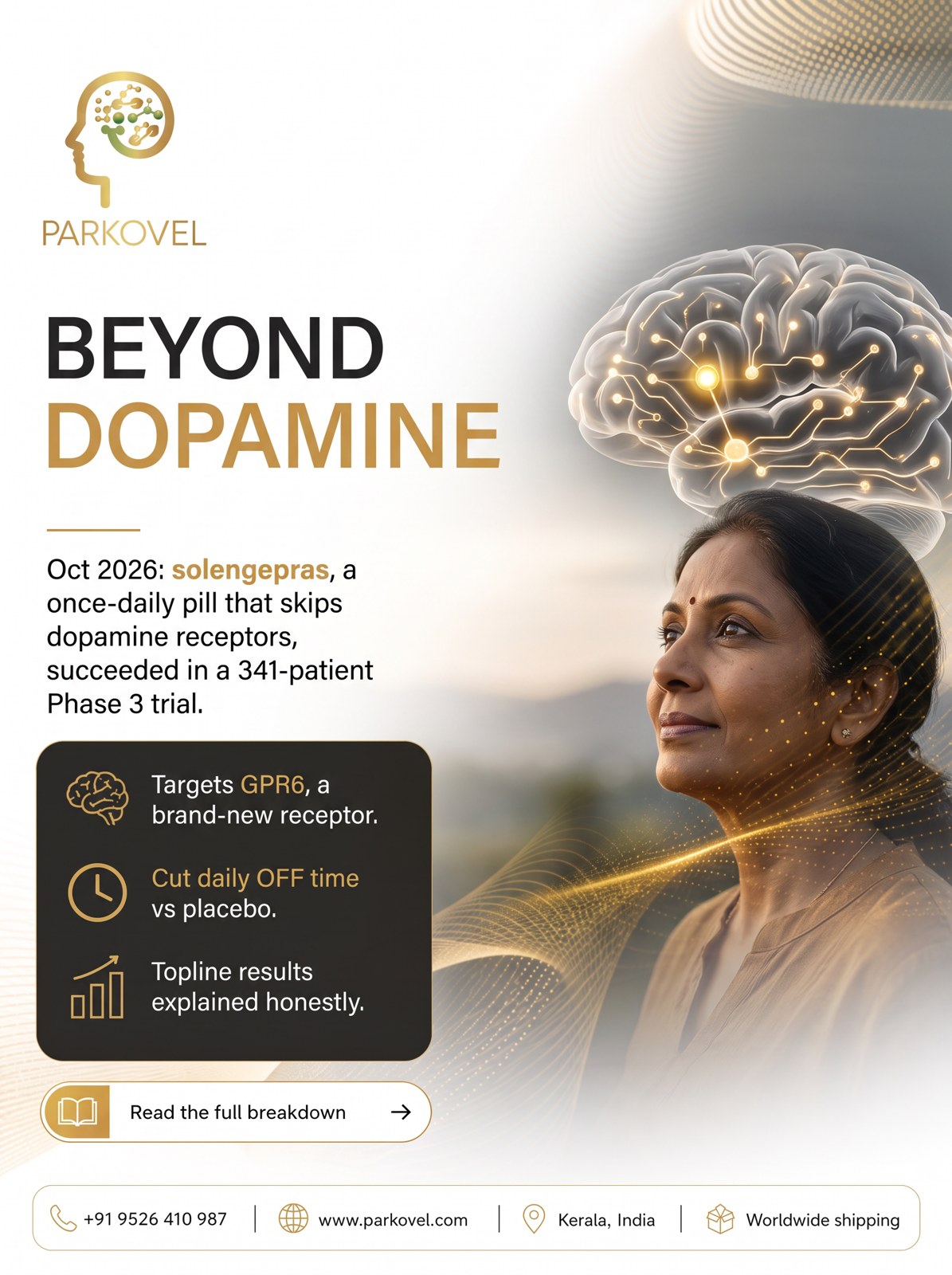
Almost every Parkinson's medicine in use today works by boosting dopamine — replacing it (levodopa), mimicking it (dopamine agonists), or slowing its breakdown (MAO-B and COMT inhibitors). On 7 October 2026, the company Cerevance announced positive Phase 3 results for a pill that takes a genuinely different approach. It's called solengepras (development code CVN424), and it doesn't act on dopamine receptors at all.
How a "Non-Dopamine" Pill Can Help
When dopamine-producing cells are lost in Parkinson's, one movement circuit in the brain — the so-called "indirect pathway" — becomes overactive, acting like a brake that is pressed too hard. Dopamine normally calms this circuit through D2 receptors.
Solengepras targets a different receptor called GPR6, found almost exclusively on those same indirect-pathway neurons. GPR6 is constantly "on," pushing the circuit in the opposite direction to dopamine. Solengepras is an inverse agonist: it switches GPR6 off. The result is that it eases the overactive brake through a side door, without stimulating dopamine receptors directly — an approach researchers hope could mean fewer dopamine-type side effects such as dyskinesia.
What the ARISE Trial Showed
The ARISE trial enrolled 341 people with Parkinson's who were already on levodopa and experiencing motor fluctuations, with an average of about 5.65 hours of OFF time a day at the start. They were randomly assigned to 75 mg solengepras, 150 mg solengepras, or placebo, once daily for 12 weeks.
- OFF time: The 150 mg group reduced daily OFF time by 1.56 hours, compared with 0.95 hours on placebo — about 37 minutes more improvement per day. The benefit appeared as early as week two.
- Good ON time: ON time without troublesome dyskinesia rose by about 0.6 hours versus placebo.
- Daily living: Scores for everyday activities (MDS-UPDRS Part II) improved by 1.91 points over placebo.
- Non-motor effects: Daytime sleepiness and quality-of-life scores also improved, although these were secondary or exploratory measures.
- Tolerability: Discontinuation because of side effects was 3.5% across all groups, including placebo.
An Honest Read of the Results
These are topline results announced by the company; the full peer-reviewed paper has not yet been published. A 37-minute daily improvement over placebo is modest but meaningful — similar in size to some established add-on medicines. The real significance is the mechanism: if solengepras is approved, it would add a new class of Parkinson's drug that can be combined with existing dopamine therapies. Cerevance has said it will discuss a New Drug Application with the FDA.
Frequently Asked Questions
Is solengepras available now?
No. It is still investigational and has not been approved by any regulator, including in India.
Would it replace levodopa?
No. In ARISE it was tested as an add-on to existing medication, not as a replacement.
Why does a once-daily pill matter?
Many people with Parkinson's take several doses a day. Solengepras has a long half-life (around 33 hours), which supports once-daily dosing and steadier levels.
Does it slow the disease?
No. Like most current treatments, it is designed to improve symptoms, not to change the underlying progression.
New mechanisms like this are good news for the long term. Today, a well-managed routine — prescribed medicine, movement, good nutrition, and supportive care such as Parkovel365 discussed with your doctor — remains the foundation.
Sources
- Cerevance / GlobeNewswire, "Cerevance Announces Positive Phase 3 ARISE Results" (7 October 2026)
- Parkinson's News Today, "Treatment may reduce Parkinson's off time, Phase 3 trial finds" (October 2026)
- Journal of Pharmacology and Experimental Therapeutics, "Development of CVN424: A Selective and Novel GPR6 Inverse Agonist Effective in Models of Parkinson Disease"