Family members often notice it before the patient does: a voice that's grown softer, words that run together, a face that seems less expressive even when emotions are unchanged. Speech and swallowing changes are among the most common — and most treatable — symptoms of Parkinson's disease, yet they're frequently overlooked until they significantly affect daily communication.
What Changes, and Why
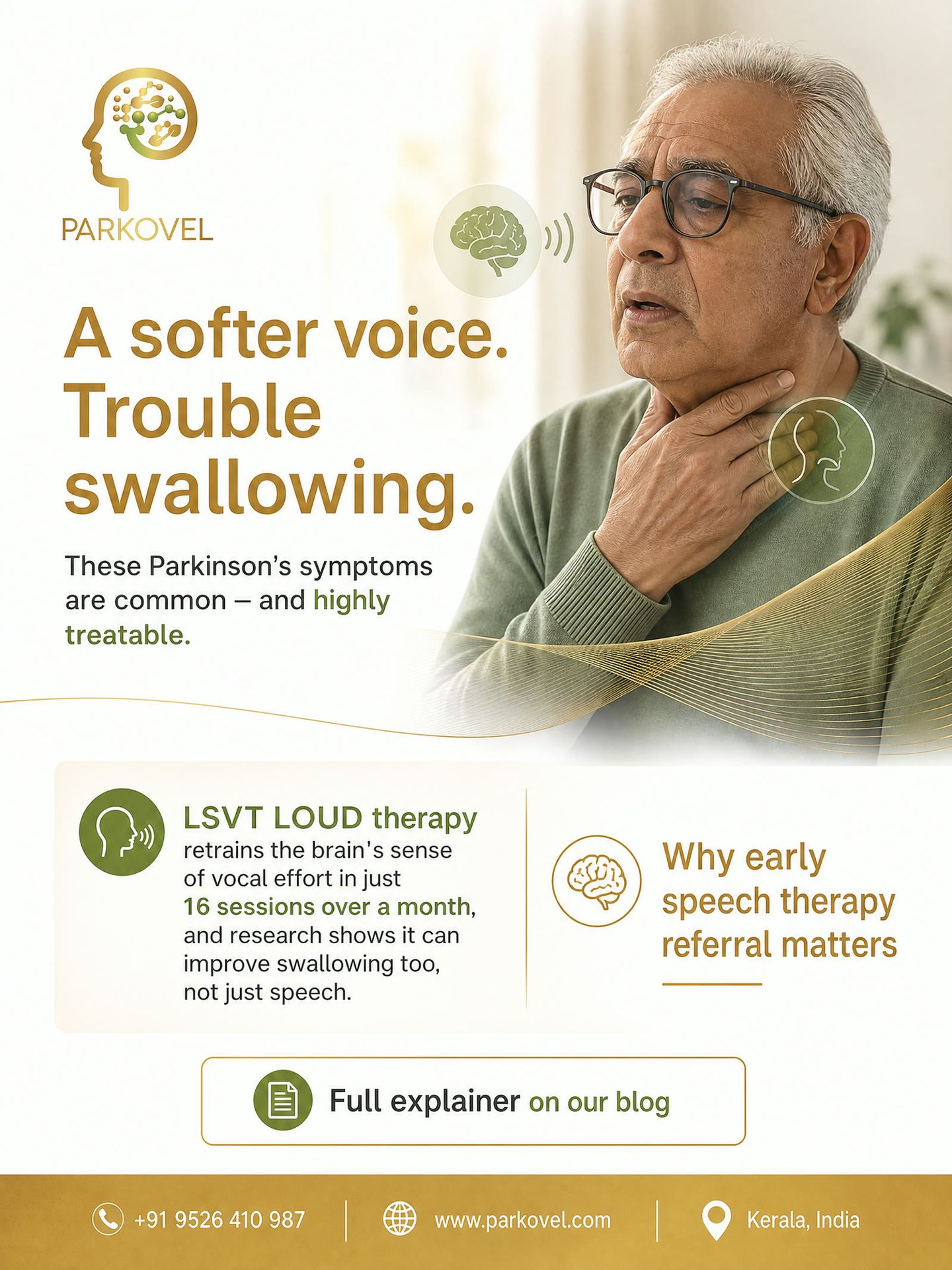
Parkinson's disease can cause speech and voice changes, including soft, slow, rapid, or unclear speech, along with facial masking that affects emotional expression even when the person feels the emotion normally. Over time, some patients also develop dysphagia — swallowing difficulty — which can lead to coughing during meals, drooling, and in more serious cases malnutrition, dehydration, or aspiration (food or liquid entering the airway).
Both problems stem from the same underlying cause as Parkinson's motor symptoms elsewhere in the body: the muscles involved in speech and swallowing become slower and produce smaller, less forceful movements, even though the person isn't consciously aware of speaking softly or moving their tongue less.
LSVT LOUD: The Best-Studied Treatment
The Lee Silverman Voice Treatment program, developed by Dr. Lorraine Ramig and colleagues, is an intensive, structured therapy given over sixteen sessions across one month. Its technique is deceptively simple: patients are trained to consciously increase vocal loudness and effort during speech, which recalibrates the brain's internal sense of what "normal" volume feels like — because in Parkinson's, patients often genuinely believe they are speaking at a normal volume when they are not.
Treatments focusing specifically on vocal loudness, such as LSVT LOUD, have been shown to be effective for speech disorders in Parkinson's disease. Importantly, the benefits extend beyond just being heard more clearly: LSVT has also shown promise in improving swallowing function, not just voice and speech — a meaningful bonus given how disruptive dysphagia can be to daily life and nutrition.
Other Speech Therapy Options
LSVT LOUD isn't the only validated program. SPEAK OUT!, developed by the Parkinson Voice Project, is another structured therapy that speech-language pathologists use alongside vocal exercises, assistive communication devices, and specific strategies for safer swallowing, such as changes in food texture, swallowing technique, and posture during meals.
Why Early Referral Matters
As with physiotherapy, the consistent theme in current research is that earlier is better. Speech and swallowing symptoms tend to be more responsive to therapy before they become deeply entrenched, and starting speech-language pathology soon after diagnosis — rather than waiting until communication becomes genuinely difficult — tends to produce better long-term outcomes.
Frequently Asked Questions
How soon after a Parkinson's diagnosis should someone see a speech-language pathologist?
Many movement disorder specialists now recommend an early referral, similar to physiotherapy, even before speech or swallowing problems become obvious to family members.
Is LSVT LOUD just about talking louder?
Not exactly — it retrains the brain's sense of effort and volume, since many patients don't perceive their own speech as quiet. The "loud" cue is a tool to recalibrate that internal miscalibration, not simply an instruction to shout.
Can swallowing therapy prevent choking episodes?
It can significantly reduce risk by teaching safer swallowing techniques, appropriate food textures, and posture adjustments, though severe dysphagia may require additional dietary modification under a specialist's guidance.
Does facial masking mean a person has lost emotional expression?
No — this is one of the most misunderstood Parkinson's symptoms. The person typically feels emotions normally; the facial muscles simply move less, which can unfortunately be misread by others as disinterest or low mood.
Communication is one of the most human parts of daily life, and it's worth protecting proactively. Alongside professional speech therapy, general strategies that support overall neuromuscular function — structured exercise, quality sleep, and a well-managed medication routine — all contribute to keeping speech and swallowing as strong as possible for as long as possible.
Sources
- Parkinson's Foundation, "Speech & Swallowing Issues"
- Michael J. Fox Foundation, "Speech and Swallowing Problems in Parkinson's Disease"
- Stanford Medicine, "Speech and Swallowing in Parkinson's Disease"