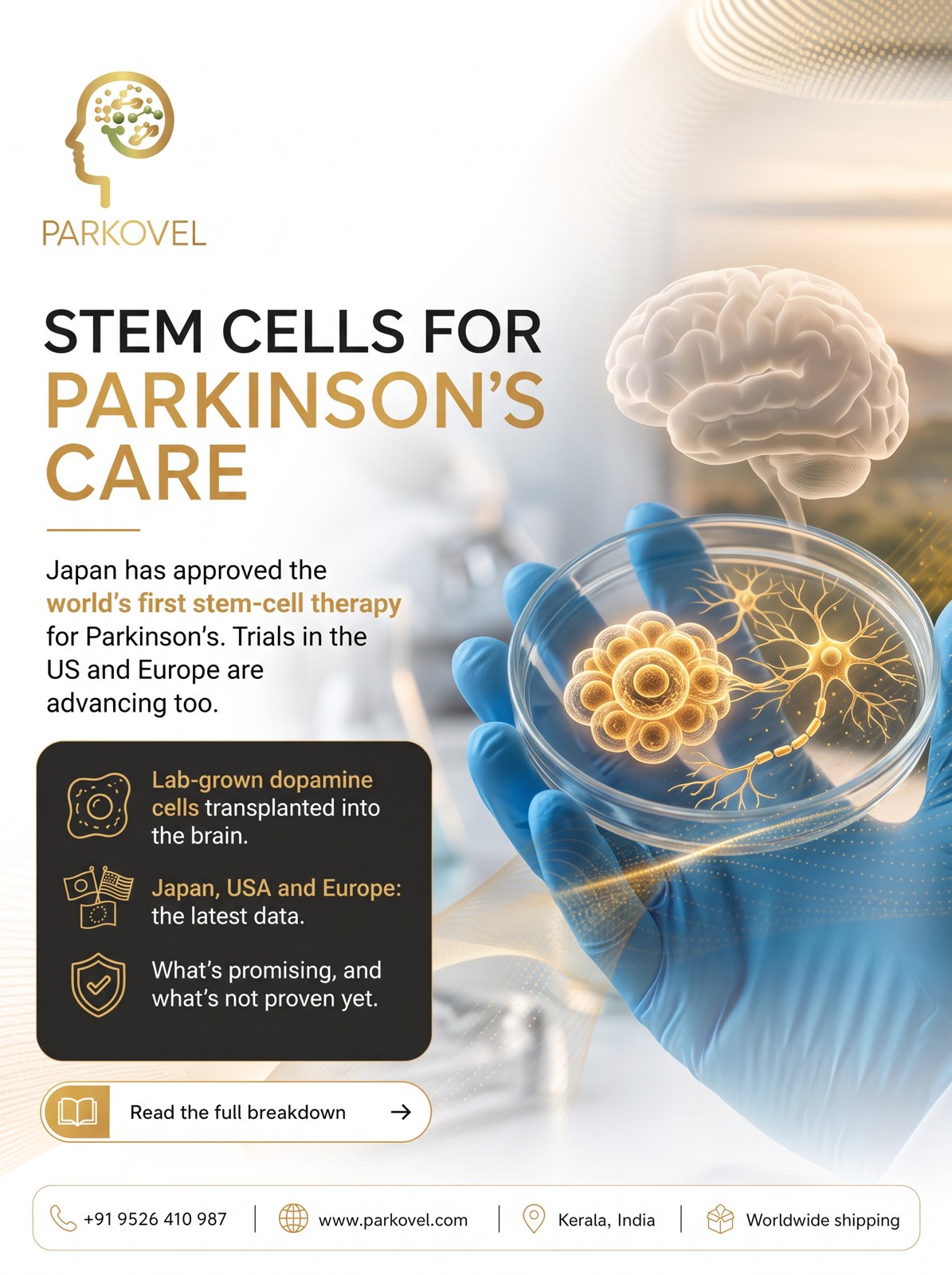
For decades, replacing the dopamine-producing brain cells lost in Parkinson's disease has been the field's most ambitious goal. In 2026 it moved from laboratory promise to regulatory reality: Japan granted conditional approval to the world's first stem-cell-derived therapy for Parkinson's, while trials in the United States and Europe reported encouraging multi-year data.
The Idea: Replace What's Been Lost
Parkinson's symptoms appear after a large share of the brain's dopamine neurons in the substantia nigra have died. Medicines like levodopa top up dopamine, but they don't replace the cells. Cell therapy aims to do exactly that: grow young dopamine-producing "progenitor" cells in the lab from stem cells, then transplant them into the striatum, the brain region that needs the dopamine.
Japan: The First Approval
In 2025, researchers at Kyoto University Hospital published a Phase I/II trial in Nature. Seven patients aged 50 to 69 received transplants of dopamine progenitor cells made from induced pluripotent stem (iPS) cells — adult cells reprogrammed into a stem-cell state. There were no serious adverse events, and brain scans showed no abnormal graft growth. Of the six patients evaluated for efficacy, four improved on the off-medication motor score and five on the on-medication score.
Based on this trial, Japan's Ministry of Health, Labour and Welfare granted Sumitomo Pharma a conditional, time-limited approval on 6 March 2026 for this iPS-cell-derived product, named AMCHEPRY. It is the only stem-cell-based Parkinson's therapy approved anywhere; the other products described below remain investigational. "Conditional" matters: the company must confirm safety and effectiveness in further studies to keep the approval.
United States: Bemdaneprocel
BlueRock Therapeutics, a Bayer company, is testing bemdaneprocel, made from embryonic stem cells. In its Phase I trial of 12 people, results through 36 months showed no graft-induced dyskinesias and no safety problems linked to the transplanted cells. In the higher-dose group, the off-medication motor score improved by an average of 17.9 points from baseline at three years. The lead investigator urged caution about the efficacy signals, given the small open-label design. A Phase 3 trial comparing bemdaneprocel with sham surgery began in 2025 and is ongoing.
Europe: STEM-PD
In July 2026, the Lund University-led STEM-PD trial presented 12-month results. Eight people received an off-the-shelf, frozen dopamine cell product. Seven completed a year of follow-up; one died of a lung infection not directly related to the cells, which may have been influenced by the year of immune-suppressing medication all participants took. PET scans suggested the grafts were surviving, and six of the seven showed signs of needing less dopamine medication.
Keeping Perspective
These are small trials — single digits to a dozen patients each — and most were open-label, so participants knew they were treated. Brain surgery, a year of immunosuppression, and long-term uncertainty are real costs. Cell therapy also replaces dopamine cells but does not stop the underlying disease process, which affects other brain regions too. It is a historic step, not yet a cure.
Frequently Asked Questions
Can Indian patients get stem cell therapy for Parkinson's?
No approved stem-cell therapy for Parkinson's is available in India. Be very cautious of clinics offering unproven "stem cell treatments" for a fee; these are not the regulated therapies described here.
Do patients still need medication after a transplant?
In the trials so far, most still take Parkinson's medicine, though some needed less.
Why do recipients take immune-suppressing drugs?
To prevent the body from rejecting the transplanted cells. In these trials, immunosuppression was given for about a year.
When might this be widely available?
Larger Phase 3 results are needed first. Realistic timelines for broad availability are measured in years.
While regenerative medicine advances, daily wellbeing still depends on the basics: prescribed treatment, physiotherapy, nutrition, and supportive care such as Parkovel365, discussed with your neurologist.
Sources
- Sawamoto et al., "Phase I/II trial of iPS-cell-derived dopaminergic cells for Parkinson's disease," Nature 641 (2025)
- APDA, "Japan Approves First Stem-Cell Therapy for Parkinson's Disease" (2026)
- BlueRock Therapeutics, 36-month Phase I results for bemdaneprocel (October 2025)
- ISSCR, "New Clinical Data Presented at ISSCR 2026 Advance Stem Cell-Based Cell Therapy for Parkinson's Disease" (July 2026)