Ask around any Parkinson's support group and you'll likely hear about vitamin B12 or vitamin D at some point — usually as a supplement someone's doctor recommended after a blood test. The science behind these two nutrients and Parkinson's is genuinely interesting, but it's also more measured than social media sometimes suggests. Here's what's actually been established.
Vitamin B12: A Real and Common Deficiency
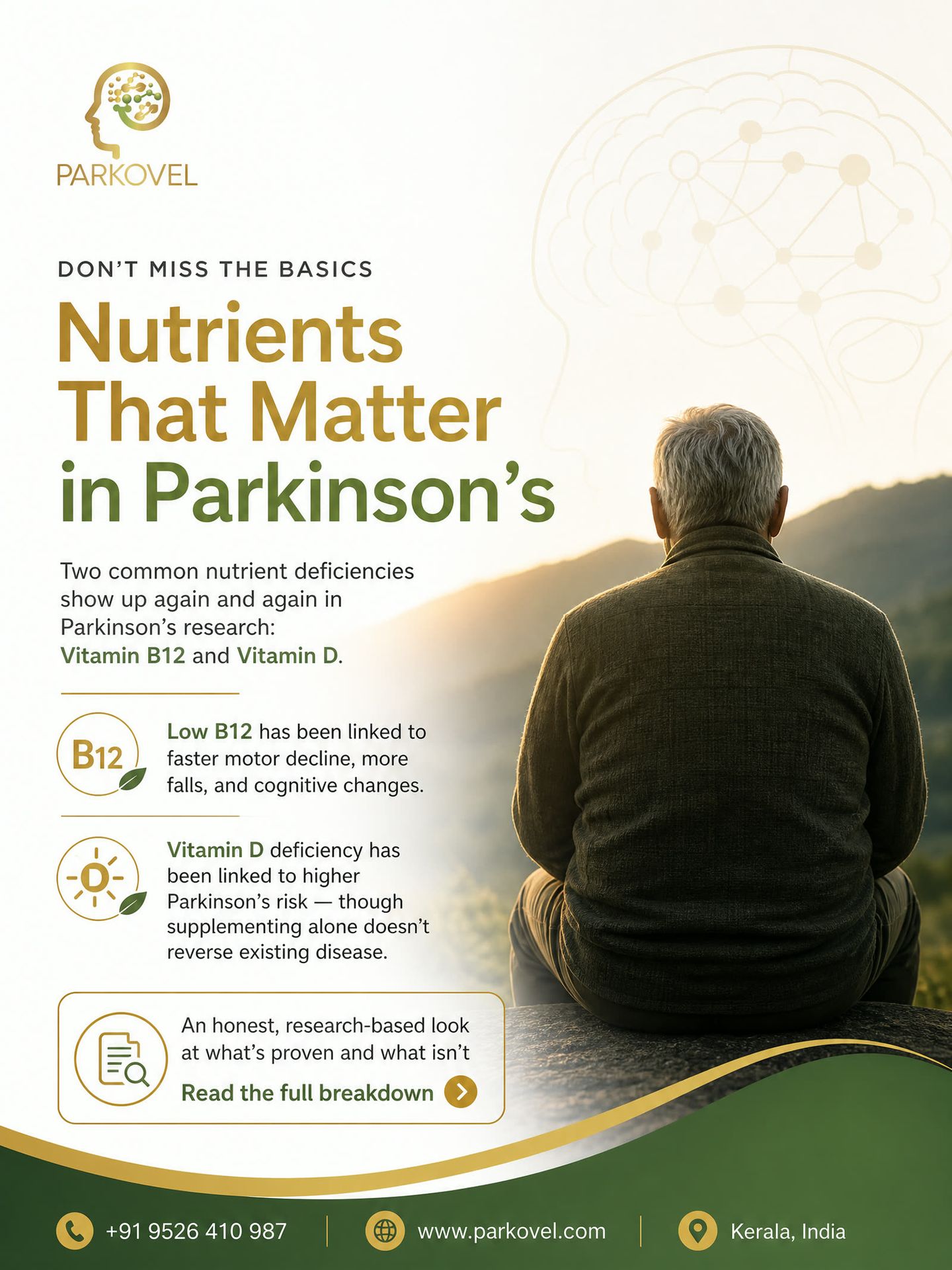
Several epidemiological studies have shown that vitamin B12 levels tend to be lower in people with Parkinson's than in healthy individuals of the same age, which is one reason neurologists frequently check B12 levels at diagnosis. Part of this may relate to how Parkinson's affects the gut, and part may relate to levodopa itself, which can lower B12 and folate levels over years of use.
The connection goes deeper than simple correlation. B12 deficiency, on its own, can cause a condition called acute parkinsonism, mimicking Parkinson's symptoms. And research has found that B12 deficiency together with elevated homocysteine (a related marker) correlates with a specific, more difficult Parkinson's phenotype — one involving earlier postural instability, more falls, faster motor progression, cognitive impairment, and visual hallucinations. Laboratory studies have even shown B12 can inhibit LRRK2 kinase activity and interact directly with alpha-synuclein, the protein central to Parkinson's pathology.
One important caveat: a 2025 genetic study looking specifically at causation found no genetic link between B12 metabolism and Parkinson's risk itself — meaning B12 deficiency likely worsens the disease course rather than causing the disease outright.
Vitamin D: Suggestive, But Not Settled
Vitamin D deficiency has been linked in multiple studies to both a higher risk of developing Parkinson's and to a reduction in dopamine levels. Research also suggests vitamin D may be involved in the accumulation of alpha-synuclein, the same misfolded protein implicated in B12 research above. Several studies have reported that people with low vitamin D are more likely to develop Parkinson's.
However, a systematic review of randomized controlled trials found the picture is genuinely mixed: supplementing with vitamin D doesn't consistently change clinical symptoms or disability levels in people who already have Parkinson's. In plain terms — deficiency appears to be a real risk factor worth correcting, but popping a vitamin D pill isn't shown to reverse or meaningfully slow existing disease.
What This Means in Practice
Both deficiencies are common, easily tested with a routine blood panel, and inexpensive to correct — which makes checking B12 and vitamin D levels a low-risk, sensible part of Parkinson's care, even though neither is a treatment for the disease itself. For people managing Parkinson's on levodopa long-term especially, periodic B12 monitoring is genuinely worth discussing with a neurologist.
Frequently Asked Questions
Should every Parkinson's patient take B12 and vitamin D supplements?
Not automatically — testing first is the right approach, since supplementing without a documented deficiency offers little proven benefit and isn't cost-free.
Can vitamin D or B12 supplements cure Parkinson's?
No. Current evidence supports correcting a genuine deficiency for general health and to avoid worsening specific symptoms, not as a disease-modifying treatment.
Why would someone on levodopa need more frequent B12 checks?
Long-term levodopa use is associated with declining B12 and folate levels over years, so periodic monitoring helps catch deficiency before it contributes to falls, cognitive changes, or nerve symptoms.
Where does sunlight fit in for vitamin D?
Modest, safe sun exposure remains one of the simplest ways to support vitamin D levels, alongside diet and supplementation guided by blood test results.
A yearly nutrient panel is a small, practical addition to any Parkinson's care routine — one that pairs naturally with the broader lifestyle and Ayurvedic approaches, including Parkovel365, that many families use to support day-to-day wellbeing.
Sources
- Journal of Neural Transmission / PMC, "Parkinson's disease and vitamins: a focus on vitamin B12" (2024)
- ScienceDirect, "Vitamin D in Parkinson's disease: A systematic review of randomized controlled trials"
- medRxiv, "Investigating the genetic relationship between vitamin B12 deficiency and Parkinson's disease" (2025)