A five-minute clinic visit once every few months has long been the main window doctors get into how a Parkinson's patient is really doing. It's an imperfect snapshot — symptoms fluctuate hour to hour, and patients often perform noticeably better in a clinic than they do at home. Wearable sensors are closing that gap by turning ordinary days into continuous clinical data.
Why Continuous Monitoring Matters in Parkinson's
Parkinson's is defined by fluctuation — "on" periods when medication is working well and "off" periods when symptoms return, often unpredictably. Wearable devices provide a discreet and user-friendly solution that reduces the burden on patients to manually record symptoms, while giving clinicians organised data on how symptoms evolve — enabling a genuinely objective assessment of disease progression and treatment response, rather than relying on memory and self-report.
What These Devices Actually Measure
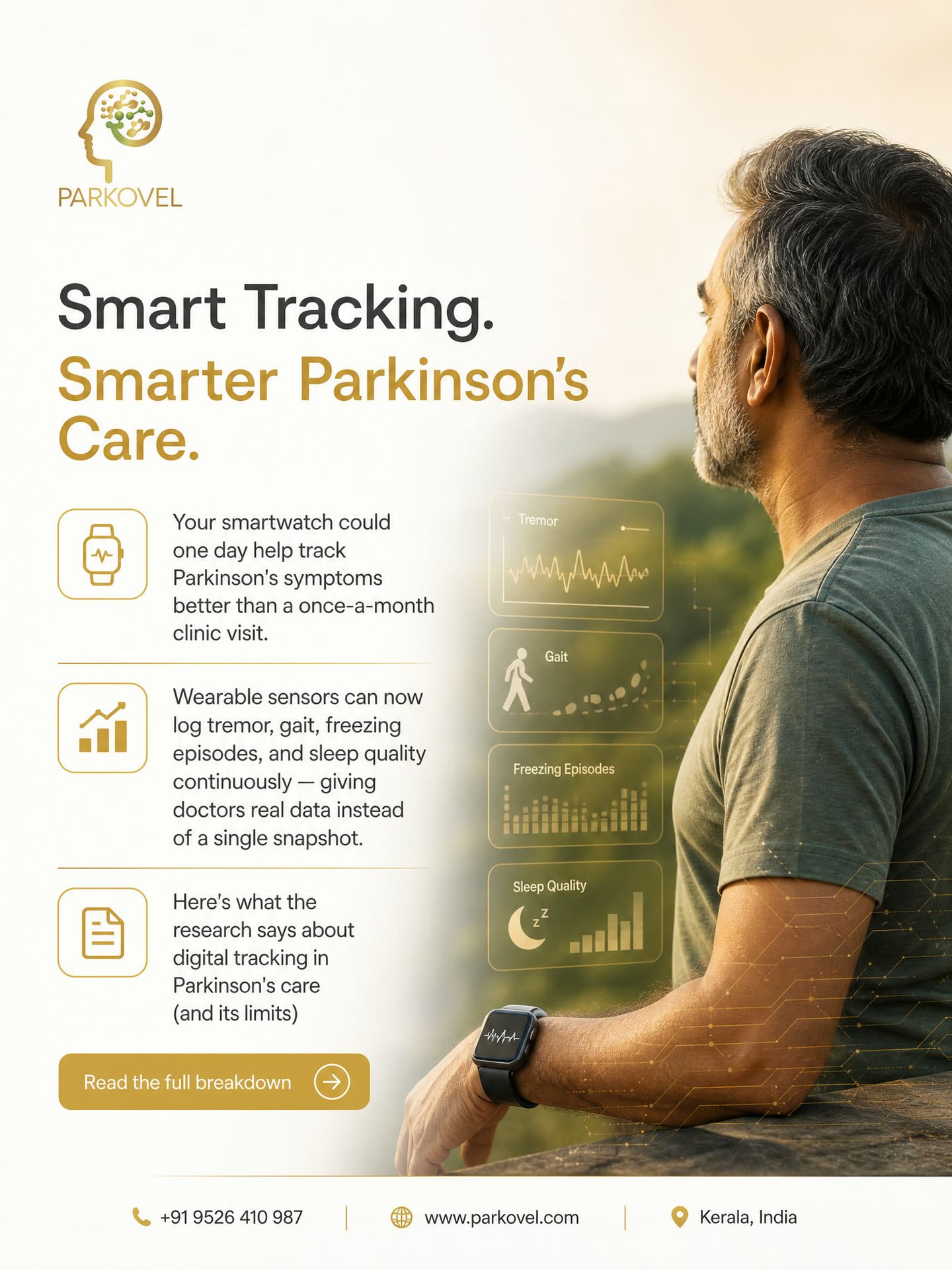
Research reviews of digital biomarkers show that inertial measurement units (IMUs) — the same type of motion sensor found in smartwatches and fitness bands — are the most common device type in Parkinson's monitoring, followed closely by smartphone-based sensing. These sensors can track tremor amplitude and frequency, walking speed and stride length, freezing-of-gait episodes, sleep quality and movement during sleep, and typing or tapping speed as a proxy for fine motor control.
Catching Problems Before They're Obvious
One of the more powerful uses of this technology lies in the prodromal (pre-diagnosis) phase. Biomarkers captured during this window can provide a diagnostic view into early disease processes, helping distinguish Parkinson's from other conditions and enabling earlier treatment — potentially years before a person or their family notices anything is wrong in daily life.
From Research Tool to Everyday Companion
What began as a research instrument is steadily becoming a caregiving tool. A smartwatch that logs a spike in tremor after a missed dose, or a gradual slowing in gait over several months, gives both patients and neurologists something concrete to discuss at the next appointment — replacing "I think I've been a bit worse lately" with actual data trends.
A Word of Caution
Consumer smartwatches (an Apple Watch or Fitbit, for instance) are not medical devices and haven't been validated the same way as clinical-grade sensors used in trials. They can be a genuinely useful personal tracking tool for noticing patterns, but they shouldn't replace a neurologist's clinical judgment or be used for self-diagnosis.
Frequently Asked Questions
Can a regular smartwatch diagnose Parkinson's?
No. Consumer smartwatches can help track patterns like tremor or activity level over time, but diagnosis still requires clinical evaluation by a neurologist.
Are wearable sensors used in Indian hospitals yet?
Adoption is growing, especially in movement disorder clinics at larger urban hospitals, though it isn't yet universal. Ask your neurologist whether digital tracking tools are part of your care plan.
What's the benefit of tracking symptoms between visits?
It gives your doctor real data on how medication timing, daily activity, and sleep affect your specific symptom pattern — often revealing things a single clinic visit would miss entirely.
Do these devices track medication effectiveness?
Yes — several research platforms specifically correlate movement data with medication timing to show how well a dose is working and when the next "off" period tends to begin.
Whatever tools a family uses to track and manage Parkinson's day to day — digital or otherwise — the goal is the same: catching changes early and responding to them, whether that means adjusting medication timing, adding physiotherapy, or incorporating supportive natural formulations like Parkovel365 alongside a neurologist's guidance.
Sources
- MDPI, "Evaluating Motor Symptoms in Parkinson's Disease Through Wearable Sensors: A Systematic Review of Digital Biomarkers" (2024)
- Movement Disorders (Wiley), "Digital Outcomes as Biomarkers of Disease Progression in Early Parkinson's Disease: A Systematic Review" (2025)
- PMC, "Evaluating the Utility of Wearable Sensors for the Early Diagnosis of Parkinson Disease: Systematic Review" (2025)