Parkinson's disease is popularly thought of as a condition of old age, which makes it especially disorienting when it strikes someone in their thirties or forties. Young-Onset Parkinson's Disease (YOPD) — diagnosed between ages 21 and 50 — is more common than most people realise, and in India specifically, it represents a substantial share of all cases.
How Common Is It, Really?
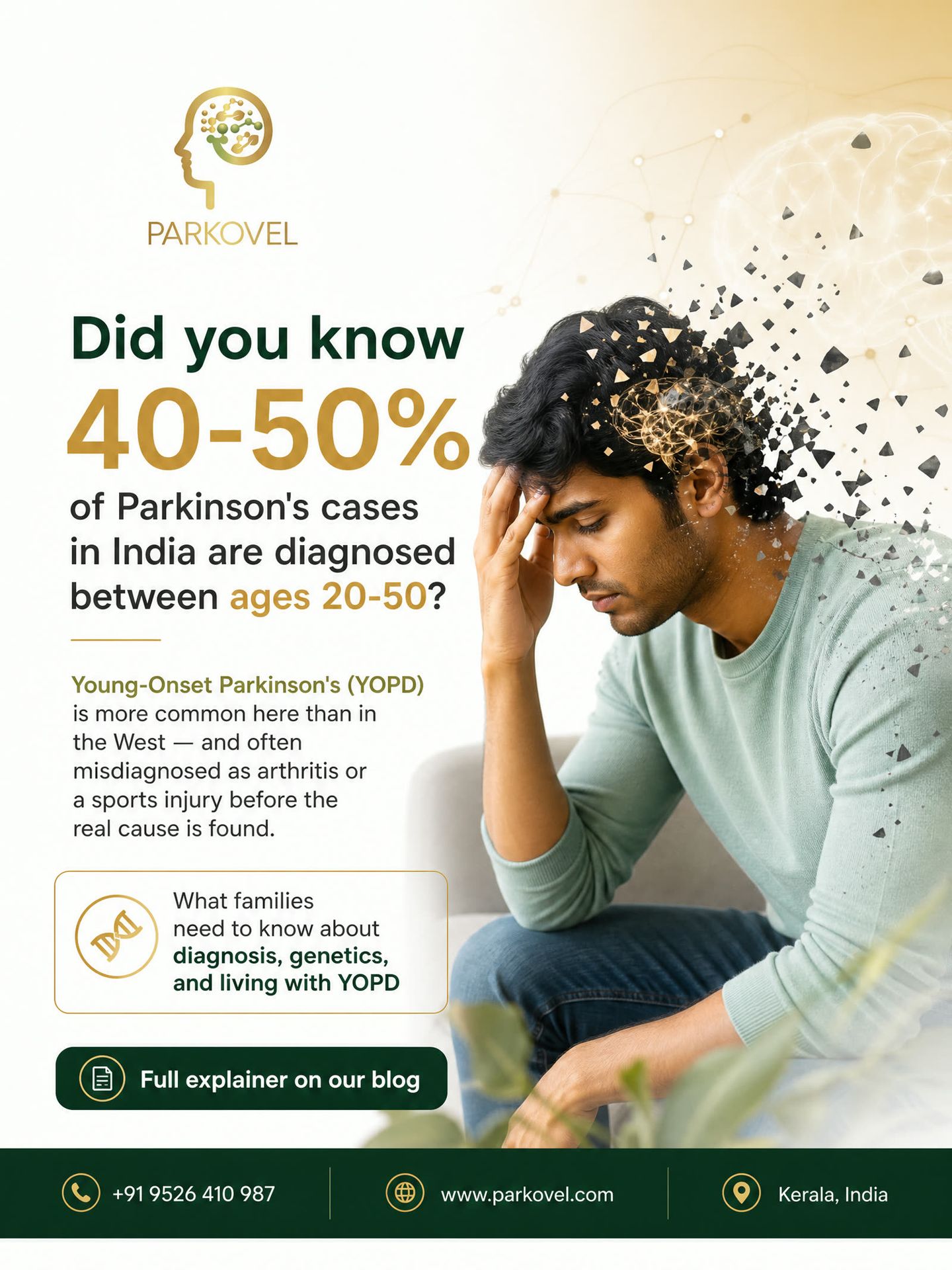
Globally, around 10% of all Parkinson's cases meet the criteria for young onset, translating to roughly 9,000 new diagnoses annually in the U.S. alone within this age range. In India, the picture looks notably different: over 40 to 50% of Parkinson's cases are diagnosed in people between the ages of 20 and 50 — a strikingly younger disease profile than in Western countries, and a pattern researchers are still working to fully explain.
Why Diagnosis Often Comes Late
One of the cruelest aspects of YOPD is how frequently it's missed or delayed, precisely because doctors — and patients themselves — don't expect Parkinson's before age 50. It's not uncommon for arm or shoulder stiffness to be attributed to arthritis or a sports injury long before Parkinson's is eventually diagnosed, sometimes after months or years of misdirected treatment for the wrong condition entirely.
The Genetic Difference
YOPD has a meaningfully different biological profile than late-onset Parkinson's. Genetic factors appear to play a larger role, with mutations in specific genes — PRKN, LRRK2, DJ-1, SNCA, and PINK1 — showing up more frequently. One in five people with YOPD carries an identifiable genetic mutation, compared with fewer than one in ten among those diagnosed later in life. This has practical implications: genetic counselling and testing are more often recommended for younger patients, both for their own understanding and for family planning conversations.
A Different Disease Course
There's a silver lining in the research: people with YOPD often experience slower symptom progression and fewer cognitive issues than those diagnosed later, though they do tend to face more medication-related side effects like dyskinesia and dystonia over the many years they typically live with the condition — simply because a longer disease duration means more cumulative medication exposure. Encouragingly, YOPD patients are often better candidates for advanced treatments like deep brain stimulation and are frequently prioritised in new medical innovation trials.
The Life-Stage Challenge
Beyond the biology, YOPD carries a distinct emotional and practical weight. A diagnosis at 35 or 40 arrives in the middle of active careers, young families, and financial responsibilities — a very different life context than a diagnosis at 70. Support networks, workplace accommodations, and family communication strategies matter enormously here, and are worth seeking out proactively rather than navigating alone.
Frequently Asked Questions
What is considered "young onset" Parkinson's disease?
Diagnosis between ages 21 and 50 is generally classified as young-onset (or early-onset) Parkinson's disease.
Why does India have a younger Parkinson's disease profile than the West?
Research is still exploring this, but genetic factors, environmental exposures, and differences in healthcare-seeking and diagnostic patterns are all being studied as contributing factors.
Should someone with YOPD get genetic testing?
It's worth discussing with a neurologist or genetic counsellor, particularly given that a meaningfully higher proportion of YOPD cases involve identifiable genetic mutations compared to late-onset cases.
Does YOPD progress faster or slower than typical Parkinson's?
Research generally shows slower motor progression and less cognitive impairment in YOPD, though medication-related complications like dyskinesia tend to appear more often due to longer treatment duration.
Whatever the age at diagnosis, an early, informed care plan — combining medical treatment with supportive measures like structured exercise, nutrition, and complementary Ayurvedic approaches — gives patients the best foundation for living well for decades to come.
Sources
- American Parkinson Disease Association, "Young Onset Parkinson's Disease (YOPD): Complete Guide"
- Parkinson's Foundation, "Young-Onset Parkinson's"
- Sarvodaya Hospital / Metropolis India, World Parkinson's Day 2026 India statistics